A note on privacy: this is a real A+ Tutoring student's story, shared with their family's consent. Names and identifying details have been changed to protect their privacy; the tutor is named with permission.
1. Hook / Status Quo
Tomas, a 6th grader who is an English Language Learner (ELL), sat in front of his screen at the start of the school year reading at a third-grade level. His i-Ready Reading diagnostic that August placed him in the 12th percentile nationally, with a Lexile measure of 570L. His vocabulary scored at a third-grade level. His comprehension of informational text came in at grade 1. On paper the numbers were sharp. In practice, the picture was softer and more familiar to any parent: a bright child who could decode the words on a page but could not slow down long enough to let the meaning land. He rushed through assignments. He answered before he had read. He drifted during long passages. His grandmother often sat nearby during homework, gently calling him back to the page.
2. The Call to Action
Tomas's mother, Claudia, had been watching this pattern for a while. He was in a homeschool-style program designed for English Language Learners, and his teacher, Hector, was doing everything he could to meet him where he was. But reading assessments kept returning the same message: Tomas was years below grade level in both vocabulary and comprehension. Math showed similar gaps. Claudia reached out to A+ Tutoring not because of one specific incident, but because she had the honest sense that schoolwork was starting to feel like tension at home, and Tomas was starting to feel unsure of himself as a learner. She wanted him to build focus, to build independent study habits, and to feel like a capable student again.
3. The Search for Solutions
Before A+, Tomas's family had leaned on the structures they already had: his homeschool program, his teacher Hector's careful follow-up, and his grandmother sitting beside him during assignments. Those supports mattered. They were not enough on their own. The gap between Tomas's grade level and his reading level was wide enough that general classroom instruction, even patient and well-designed instruction, could not close it inside a normal school week. What Tomas needed was somebody who could sit with him one-to-one, slow him down, and teach him how to read for meaning rather than for speed. Claudia and Hector agreed it was time to add a dedicated tutor to Tomas's team.
4. The Match
A+ paired Tomas with Fidah W., a reading-focused tutor whose style was warm but exacting. From the first session, Fidah did something different from what Tomas was used to. She refused to let him race.
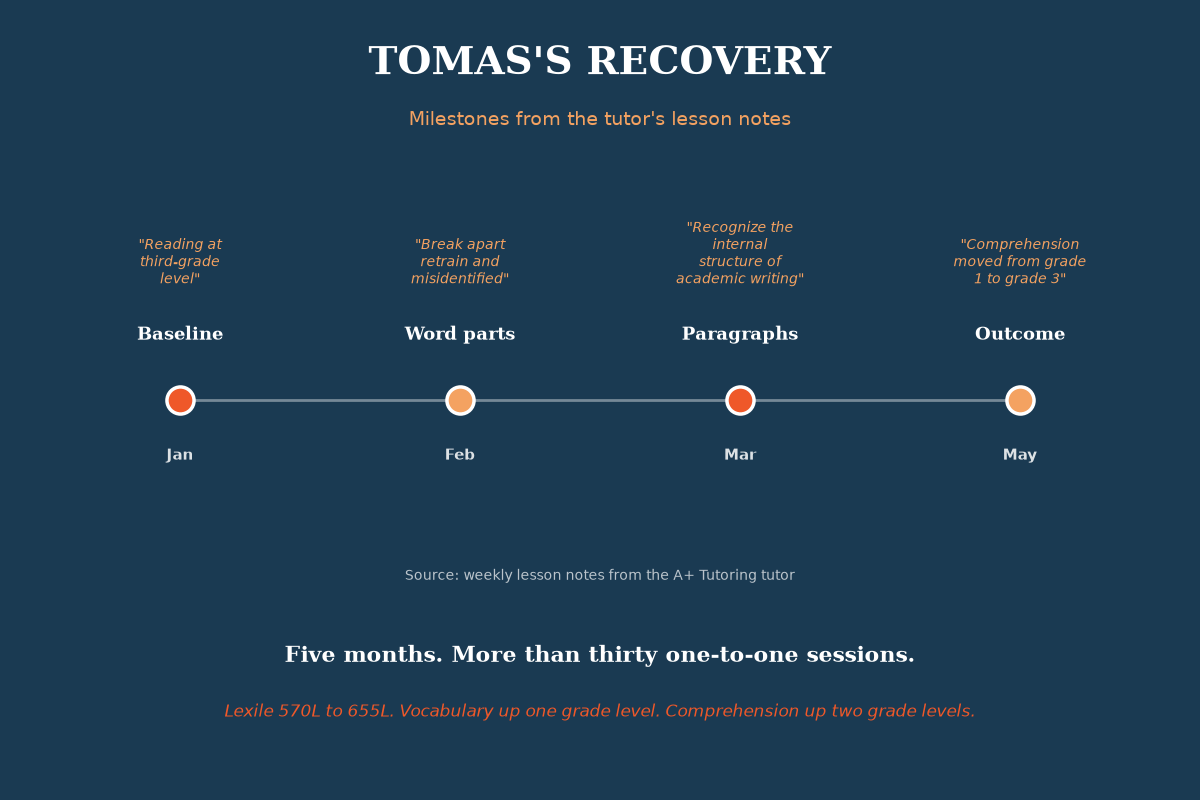
She slowed the reading down to the sentence. She stopped on individual words: gentrification, resilience, precision, craftsmanship, and asked him what they meant. She broke big words into pieces: re- and -train, under- and -perform. She used an "I do, we do, you do" rhythm so he always saw a model before he had to try. And she picked texts that mattered to him personally. Passages about automotive technicians, about dog training, about powder coating and trade careers. She picked them because Tomas had real interest in hands-on work and in understanding how people make a living. Hector later noted that Fidah's style was closer to what Tomas's family already expected of him at home: serious and clearly focused on real work. Tomas took it seriously too.
5. The Work
Over roughly five months and more than thirty sessions, Fidah built a repeatable routine with Tomas. Every lesson blended four things: a short grammar or vocabulary warm-up; a close reading of an informational passage; structured comprehension questions that required him to go back into the text; and a brief speaking or writing task that asked him to explain his thinking out loud.
She drilled the small things that unlock the big things. They worked on there / their / they're until he stopped guessing and started checking the meaning of the sentence. They worked on prefixes and suffixes until he could break a word like misidentified into parts. They worked on turning verbs into nouns (develop into development, decide into decision) so he could recognize how academic writing is built. They practiced finding the main idea, then finding two pieces of evidence, then explaining why that evidence mattered.
Fidah was honest in her notes about the hard sessions too. Tomas had days when his focus slipped, when he tried to answer before reading, when he needed to be redirected back to the task. She did not pretend those days didn't happen. She wrote them down, named them clearly, and used them to shape the next lesson. His grandmother stayed close during many sessions, which Fidah noticed made a real difference in his engagement.
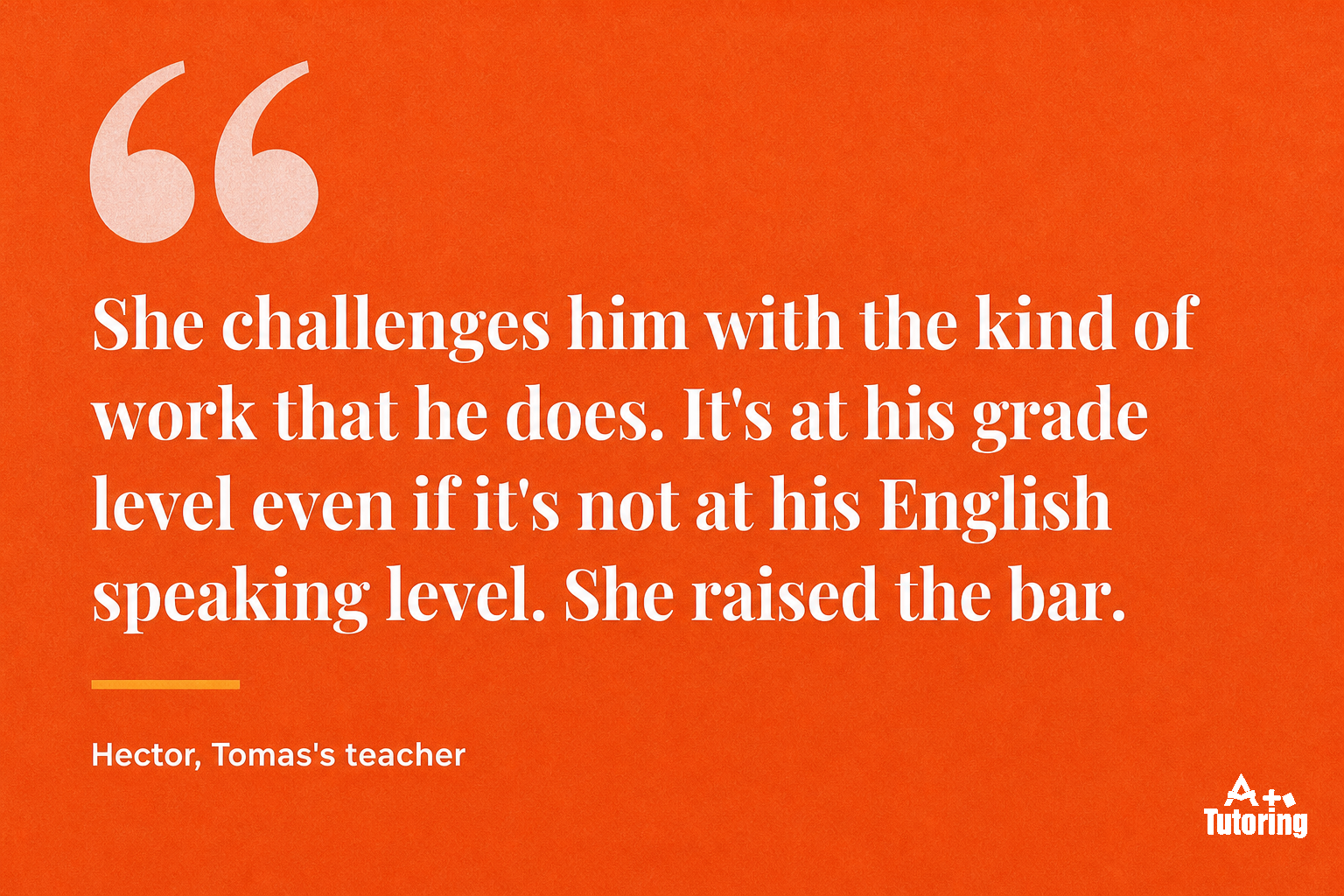
"She challenges him with the kind of work that he does. It's at his grade level even if it's not at his English speaking level. She raised the bar."
— Hector, Tomas's teacher
6. The Turning Point
The shift did not arrive as a single dramatic moment. It arrived the day Tomas stopped guessing. In a lesson on paragraph structure, Fidah gave him sentences out of order and asked him to rebuild the paragraph. He did not rush. He read each sentence, decided which one introduced the topic, which ones supported it, and which one closed it. Then he explained his reasoning. He had done the same kind of task weeks earlier and skipped straight to an answer. This time he slowed down, checked the meaning, and talked through the logic. Fidah wrote in her notes that night that Tomas had begun to "recognize the internal structure of academic writing." For a student who had spent most of his school life sprinting past meaning, that was the moment the sprint ended.
7. The Outcome
The numbers followed. By May, Tomas's i-Ready Reading diagnostic placed him in the 14th percentile nationally with an overall placement still at grade 3. Underneath that headline, the story was very different. His Lexile measure had climbed from 570L to 655L. His Vocabulary moved from grade 3 to grade 4. His Comprehension: Informational Text moved from grade 1 to grade 3, a two-grade-level jump in a single school year. On an interim diagnostic in December, he was already at the 32nd percentile overall with a Lexile of 830L, showing just how much growth the year contained. In math, his overall placement rose from grade 3 (16th percentile) to grade 5 (26th percentile) across the same window. His measurement-and-data domain moved from grade 1 all the way into the early grade 6 range.
The scores are only half of it. Hector, his teacher, described the change this way:
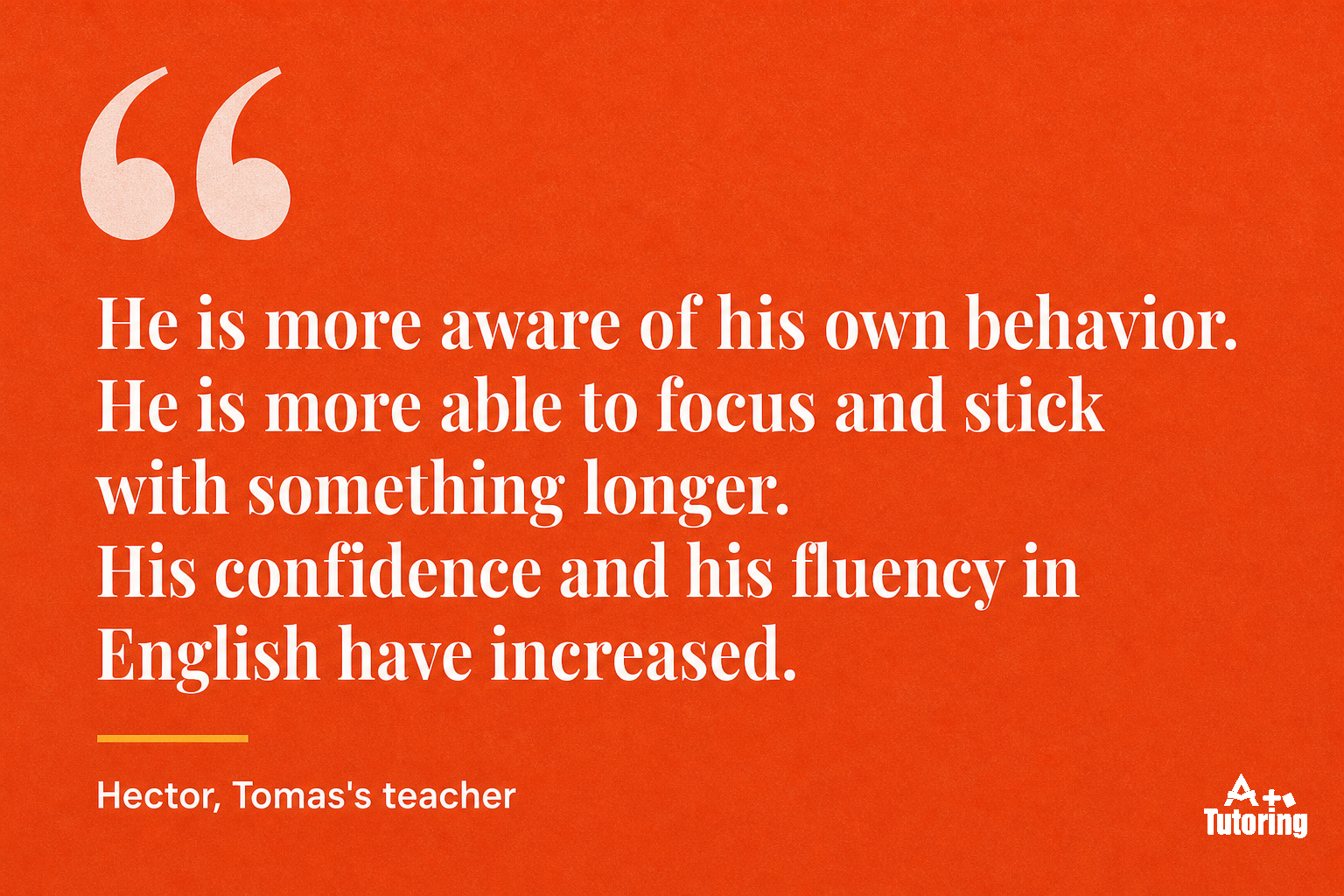
"He is more aware of his own behavior. He is more able to focus and stick with something longer. His confidence and his fluency in English have increased."
— Hector, Tomas's teacher
Claudia described him as more independent, more self-driven, and more willing to take on challenges, the exact things she had asked for at the start.
8. Where They Are Now
Tomas finished the spring sessions ready for 7th grade reading and already on his family's list for math tutoring next year. His grandmother is still nearby. Hector is still on his team. Fidah's final note to the family said it plainly: Tomas is capable, intelligent, and thoughtful, and he now has the tools to show that in school. The work continues. More challenging texts, more independent writing, and a steady move toward grade-level math. But the posture has shifted. A student who used to race past meaning now stops to look for it.
If your child is below grade level in reading, our team can talk through what's actually going on: the diagnostic scores, the classroom picture, and what an at-home tutoring plan could look like.
A+ Tutoring is the proud holder of the NSSA Tutoring Program Design Badge (2024–2026), awarded by Stanford University's National Student Support Accelerator after an evidence-based review of our program's design and alignment to Tutoring Quality Standards.