.jpg?width=110&height=79&name=Hi-Res%20Logo%20%20(320%20%C3%97%20230%20px).jpg "Hi-Res Logo (320 × 230 px)")
.jpg?width=145&height=104&name=Hi-Res%20Logo%20%20(320%20%C3%97%20230%20px).jpg "Hi-Res Logo (320 × 230 px)")
A note on privacy: this is a real A+ Tutoring student's story, shared with their family's consent. Names and identifying details have been changed to protect their privacy; the tutor is named with permission.
Henry, a 6th grader at a charter school in Southern California, used to sit at the kitchen table and wait. He'd stare at his math homework, pencil untouched, hoping his mom would just tell him the answer. Math was the subject he dreaded most. And he said so, out loud, often. By midyear, his i-Ready diagnostic told the same story his frustration did: he was testing at a 5th grade level across every domain, stuck there since the start of the school year despite classroom instruction. His mother, Gloria, watched the pattern repeat itself and knew something had to change. Six months later, Henry finished his 6th grade math coursework early, moved up to an early 6th grade placement, hit the 48th national percentile, and, in his mother's words, did "a one-eighty." This is how that shift happened.
The Homework That Never Got Started
For months, math homework at Henry's house followed the same script. He'd sit down. He'd look at the problem. He'd wait. Gloria described it plainly on our call: "He didn't really wanna put much effort into it. He really didn't like math at all. It was his worst subject. He literally would say that."
That's the part that got to her. Not the wrong answers. The not-trying. Henry is a quiet, thoughtful kid, and Gloria could see him shutting down before he ever picked up his pencil. Math had become the subject he had already decided he couldn't do, and every homework session confirmed it. He wasn't looking for a strategy. He was looking for someone to hand him the answer so it would be over.
The Score That Didn't Move
The turning point for Gloria wasn't a single dramatic moment. It was a data point that refused to change. Henry's Fall i-Ready Math Diagnostic placed him at Grade 5, one full year below where a 6th grader should be. His midyear i-Ready came back in early December. Same result: overall placement at Grade 5, with an overall scale score of 484 and a national percentile of 50 that masked how much of his 6th grade year was slipping past him.
"In the beginning of the year, he was a grade five level, and he's a sixth grader. And throughout his whole thing, he was showing grade five. And then in midyear, again, same thing. There wasn't any improvement at all. So that's where our school recommended getting him a tutor." — Gloria, Henry's mother
Two diagnostics. No movement. That was the moment Gloria stopped waiting for it to click on its own.
What Had Already Been Tried
Henry wasn't neglected. He was enrolled in a well-regarded charter school, doing his assigned work, sitting through math instruction like every other 6th grader. Gloria was involved. She sat with him during homework, she talked to his school. His school ran two i-Ready diagnostics and flagged the flat trajectory. The school itself was the one who recommended one-on-one tutoring, which is not a small thing for a school to say. They had done what they could inside the classroom. What Henry needed was the thing a classroom can't give a quiet kid: a person across from him, watching him think, refusing to hand him the answer.
Meeting Hannah
A+ matched Henry with Hannah Thorn, a math tutor whose style suited exactly the kid Henry was: patient with a shy student, structured enough to build confidence, and unwilling to rescue him from productive struggle. From the intake, A+ knew where to focus: the three i-Ready domains where Henry was weakest at midyear, which were Number and Operations, Algebra and Algebraic Thinking, and Measurement and Data. Geometry, which would later become its own story, was set aside for the first phase of work.
The first sessions were quiet. Henry didn't say much. But something Gloria noticed right away, and mentioned on our call, was that Hannah made him feel comfortable enough to think out loud instead of freeze. "My son was really shy," she said, "but she made him feel so comfortable. She allowed him to really think out how to do the problem."

That single shift, from waiting for an answer to attempting one, was the whole ballgame.
The Work, Week by Week
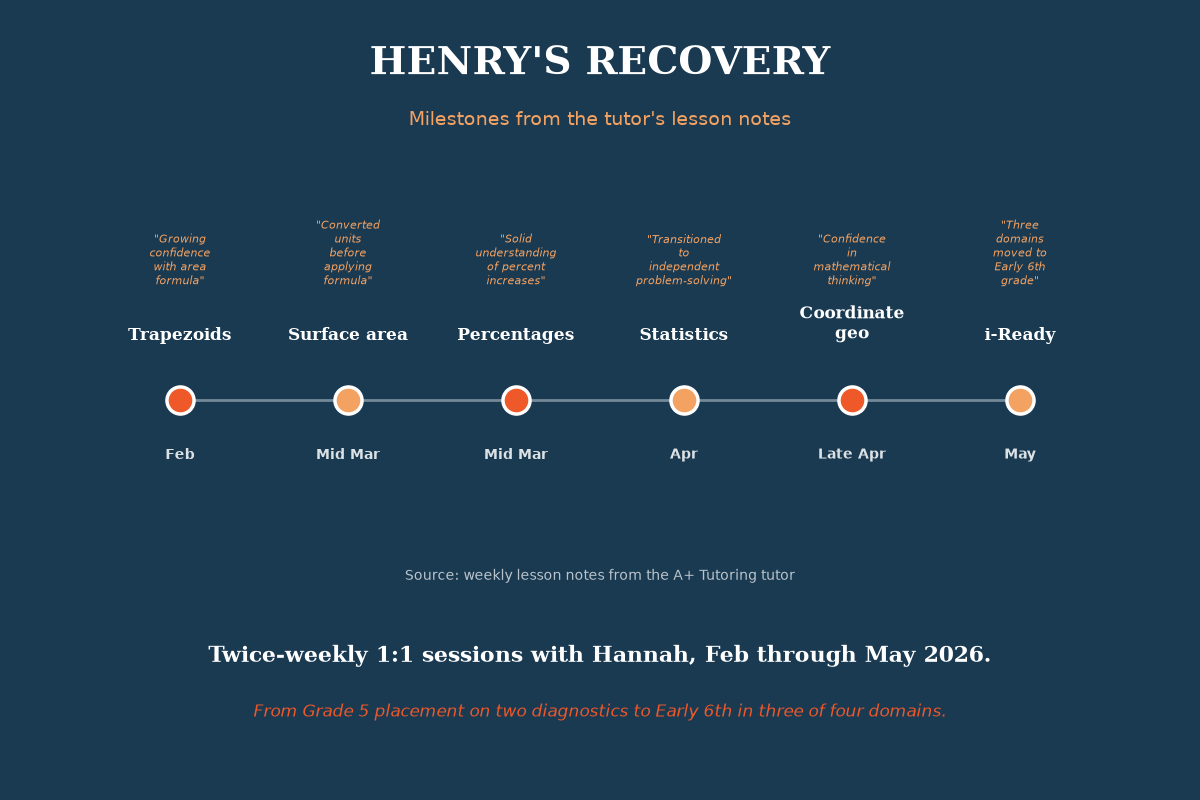
Henry and Hannah met twice a week, Wednesdays and Thursdays, right up against his school's math cadence. Hannah's session notes read like a careful ladder. In February, they worked through the area of trapezoids, then composite figures where Henry had to subtract a smaller known shape from a larger one to find the remaining region. In March, they moved into surface area and volume of prisms and pyramids, including problems where the dimensions were given in different units and Henry had to convert before applying a formula. Percentages in real-world financial scenarios, calculating 2%, 7%, 13% increases on a salary, came in mid-March.
By April, once Henry had completed his classroom math curriculum ahead of schedule, Gloria asked A+ to shift from homework support into systematic review. Hannah restructured the sessions around retention and readiness for 7th grade. They worked through statistics: mean, median, mode, five-number summary, interquartile range, mean absolute deviation using dot plots. They worked through histograms and grouped data. They moved into coordinate plane geometry, angle types (Hannah taught Henry to remember "acute" as a "cute" small angle and "right" as a capital L), and multi-step problems combining coordinate geometry with area of compound figures.
Session after session, Hannah's notes repeat the same phrasing: "quickly grasped the concept," "self-corrected when small errors occurred," "transitioned from guided practice to independent work." Henry was becoming a math student.
The Moment It Clicked
It didn't happen in one lesson. It happened the day Gloria realized Henry was no longer waiting for her at the kitchen table.
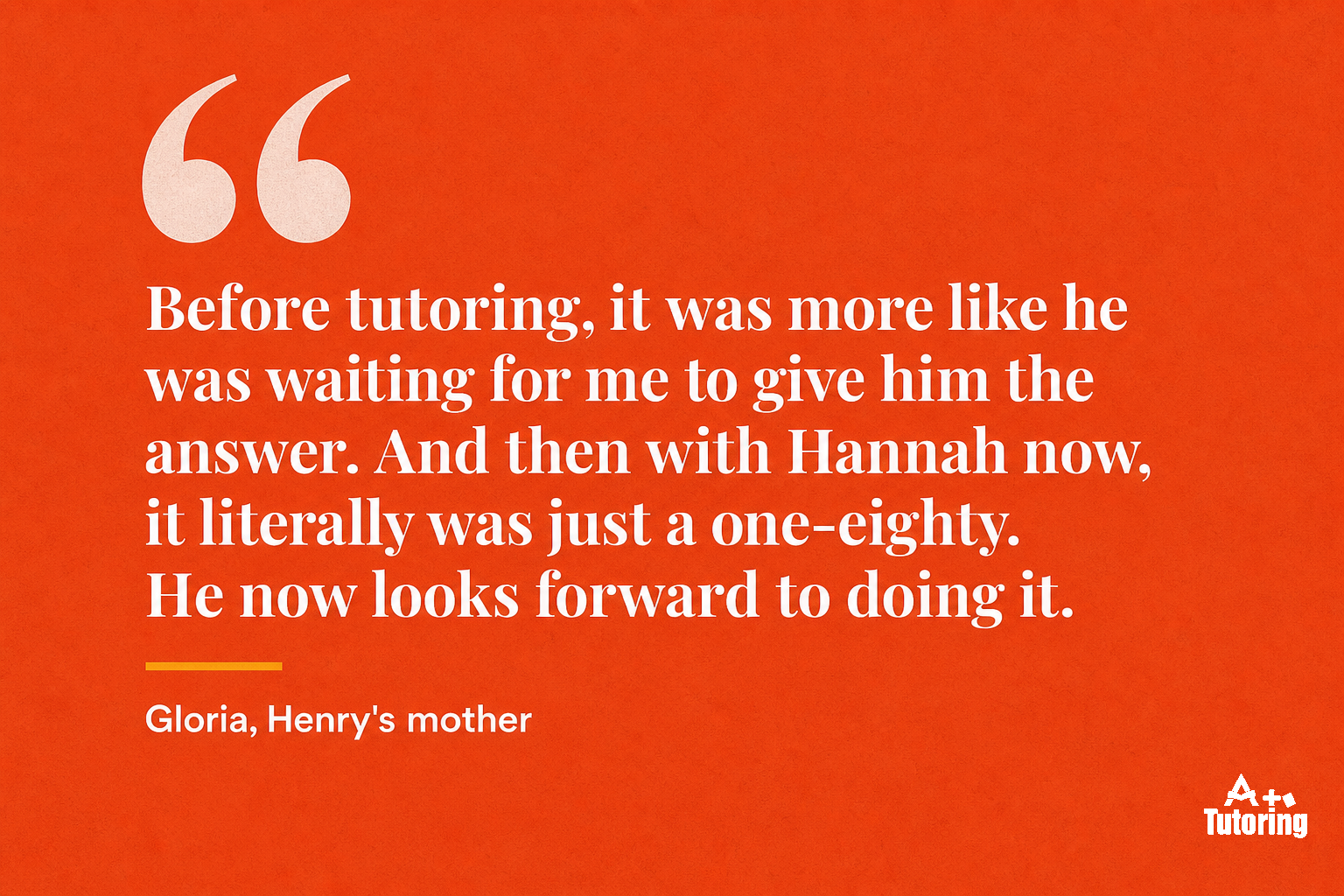
"Before tutoring, it was more like he was waiting for me to give him the answer. And then with Hannah now, it literally was just a one-eighty. He now looks forward to doing it. He feels like it's a lot easier to do. Like, he feels like he's able to think out how to do the problems now." — Gloria, Henry's mother
That's the sentence a parent remembers. Not the score change. The shift in her son's posture. He looks forward to it. He thinks it out. The dread is gone.
The Scores Caught Up
On April 28, 2026, Henry took his end-of-year i-Ready Math Diagnostic. Here is what changed:
- Overall placement moved from Grade 5 (midyear scale score 484) to Grade 5 with a scale score of 491, up seven points. But the meaningful shift was underneath the overall number.
- Number and Operations: from Grade 5 to Early 6th grade (scale score 494).
- Algebra and Algebraic Thinking: from Grade 5 to Early 6th grade (scale score 505).
- Measurement and Data: from Grade 5 to Early 6th grade (scale score 498).
- National norm percentile: 48th percentile, with a Quantile measure of 815Q.
Three of the four domains Hannah and Henry had focused on moved a full grade level in one semester. The i-Ready report noted Henry now demonstrates "good quantitative reasoning skills," the exact area the fall diagnostic had flagged as needing intervention. Geometry, which they hadn't yet worked on before the test, was the one domain that didn't move. They've spent the final weeks of the school year on it, and Gloria is watching for that score to shift on next year's fall diagnostic.
"Henry drastically improved in math. From Henry saying math is his worst subject, getting frustrated with math work, and math concepts not clicking, to now, he looks forward to math and grades drastically improved — all thanks to Hannah, his tutor. She's amazing." — Gloria, Henry's mother
Hannah's final session note for the year closed with a certificate of achievement she made for Henry and a plan for the summer: keep multiplication facts and basic geometry warm, and come back ready for 7th grade.
Where Henry Goes From Here
Henry wants to come back next year, and Gloria is asking for Hannah again. The charter school that recommended a tutor in the first place will see the growth on his next diagnostic. And the kid who used to sit at the kitchen table waiting for someone to hand him the answer now sits down and starts.
That's the outcome that matters. Not the seven-point scale-score bump or the jump into the Early 6th band. It's a 6th grader who looks at a math problem and thinks, I can do this, and then does it.
If your child is stuck on a flat trajectory in math, the same score, the same grade level, the same homework battles, our team can talk through what's actually going on and what a plan might look like.
Talk to A+ About Your Child's Math Plan
Learn more about how A+ works with families one-on-one or explore our homeschool and charter-school tutoring support.