

A note on privacy: this is a real A+ Tutoring student's story, shared with their family's consent. Names and identifying details have been changed to protect their privacy; the tutor is named with permission.
Jack is a 10th grader in a homeschool charter program. For as long as his mother Carolina could remember, test day was the hardest day of the week. He'd sit down at the kitchen table to take a math assessment, and something in him would shut off before the first question. He has an IEP and had always had accommodations, but as the math got harder each year, the gap between where he was and where his grade level sat kept widening. By the start of his sophomore year, he scored at a fifth-grade level on his fall diagnostic. Five grade levels below where a 10th grader is expected to be. Within one school year, after just a few months of weekly tutoring, he gained 25 points and moved up to a seventh-grade placement. This is the story of how that happened.
The homework table that wasn't working
The first thing to understand about Jack is that he is not a student who dislikes learning. His family homeschools through a charter, which means Carolina sees every assignment, every quiz, every moment of frustration up close. She saw the pattern early: Jack could sit with a concept, talk it through, even nod along. And then, the moment a test was in front of him, something would collapse.
"My son struggles with test taking more than anything," Carolina said in her own words. He would score low. Not because he didn't know the material, but because the testing environment itself undid him. Over the years, he'd worked with different support people through his IEP. Some helped. Some made it worse. By the time he hit 10th grade, with algebra and geometry stacking on top of foundational skills he'd never fully locked in, Carolina could feel the math slipping further out of reach.
The moment Carolina knew she needed outside help
Fall diagnostics made it official. Jack sat for his i-Ready Math Diagnostic in August and scored 472, a fifth-grade placement for a student in 10th grade. His geometry was placing at fourth grade. "Every time it came to test taking for math and language arts, he would always score really, really low," Carolina said. [/PULL QUOTE]
A number on a report is one thing. The feeling of watching your 10th grader test at a fifth-grade level is another. Carolina knew the standard interventions through the IEP weren't closing the gap. The charter recommended A+ Tutoring. She wasn't sure. Her family already juggled a full homeschool schedule, and she worried adding one more thing would tip Jack into overwhelm.
What had already been tried
Before A+, Jack's support had come through the structures a family uses when a child has an IEP: school-side accommodations, a rotation of specialists and aides over the years, and parent-led support at home. Some of those relationships were steady; some weren't. "He's had different people he's worked with throughout the years. I was like, oh, hopefully it's not one of those that stresses him out. But it was definitely the opposite." [/PULL QUOTE] That sentence carries a lot of the weariness parents of students who receive special-education services know well. The hope that this one, finally, will be the right fit.
Finding the right tutor
A+ approached the match the way we always do: not by subject alone, but by fit. Jack needed more than a math expert. He needed someone who could lower the temperature on test anxiety, meet him where his foundations actually were, and make the one-hour session feel like a conversation rather than another assessment.
Frederick S. was paired with Jack. From the first session, something shifted. Frederick didn't start with a drill. He started by asking Jack what his class was working on that week, then built the session around that. The sessions ran twice a week at the cadence the family could sustain alongside homeschool. Carolina watched the dynamic develop and realized within the first few weeks that this wasn't going to be one of the hard ones.
The Work, Week by Week
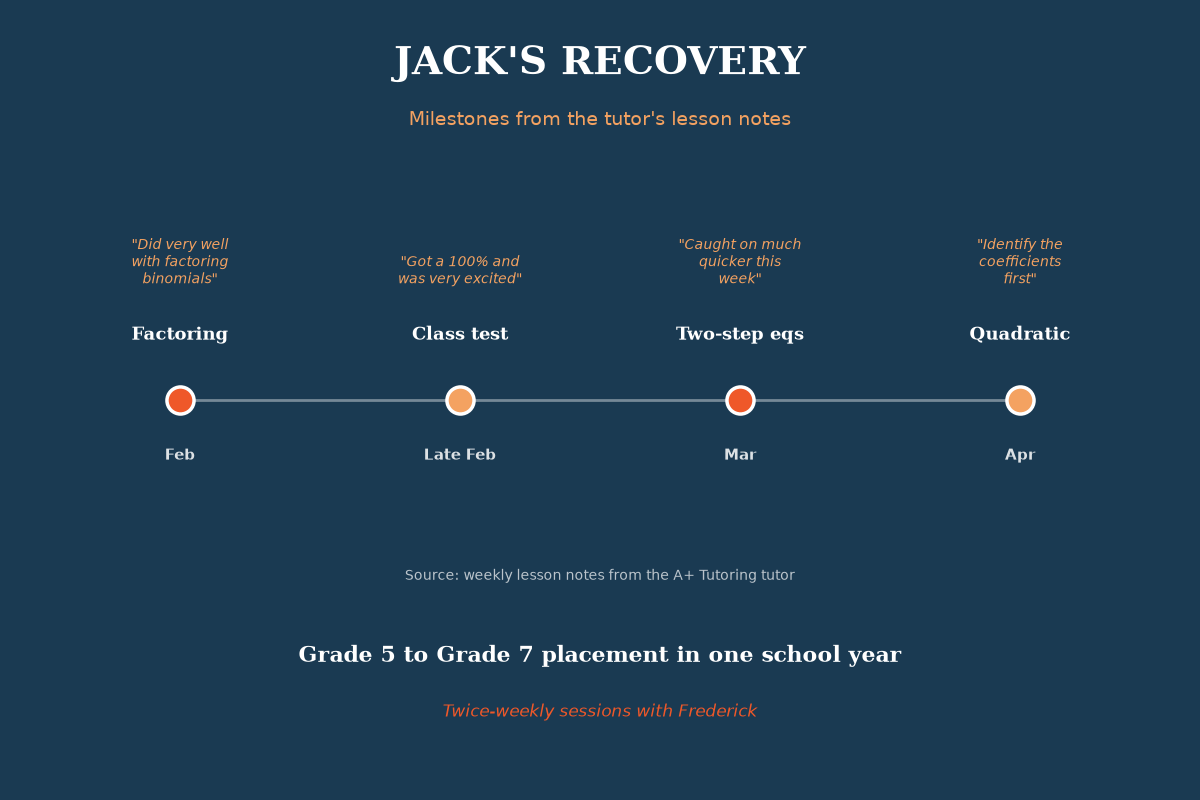
The sessions had a rhythm. Frederick would open by asking Jack what his class was covering, then meet him at the edge of that material. In February, they worked through factoring trinomials using the FOIL method and then moved into multi-step equations with variables on both sides. Jack would get it in session, do the homework for next time, and come back ready to build on it.
When things got hard, and they did, Frederick would slow down and restructure. When Jack hit the quadratic formula for the first time in April, he was overwhelmed. He'd never seen it before. Rather than push through, Frederick broke the problem into two stages: first, just identify the coefficients. Don't solve. Just name what a, b, and c are in each equation. "I think he felt overwhelmed," Frederick wrote in his session notes, "so once they talk about it in class I will be able to piggyback off of the teacher and continue having Jack gain comprehension."
That instinct, to slow down rather than double down, is what started unlocking Jack. By late February, he'd walked into a class test he'd been dreading and scored 100%. He was "very excited about it," Frederick noted. They celebrated the win and moved to the next unit.
Alongside the math, Frederick was teaching test-taking strategy out loud. Take your time. Take breaks when you need them. Double-check your answers before you submit. You can go back. The small, concrete moves that most students who struggle with test anxiety have never been explicitly taught.
The turning point
The shift wasn't a single test score. It was the first time Carolina heard her son talk about testing without dread. "He had a wonderful time. He had a pleasant time with the tutor. And it worked out for him." [/PULL QUOTE] A student who used to shut down at the sight of a math test was now sitting down to one and going back to double-check his work, because someone had told him he could.

The outcome
The numbers tell the second half of the story.
- Fall 2025 i-Ready Math Diagnostic: 472, Grade 5 placement
- Spring 2026 i-Ready Math Diagnostic: 497, Grade 7 placement
- Gain: +25 scale score points, moving up two grade-level bands in a single school year
- Domain movement: Geometry rose from a Grade 4 placement to a Grade 7 placement; Measurement and Data landed at Grade 8
All of this after just a few months of twice-weekly sessions with Frederick.
The softer outcomes land just as hard. Jack's teacher at the charter noticed the growth. He started talking more positively about school. He became more willing to take on the kind of challenges he would have avoided a year ago. "The tutor was amazing. He helped my student with math and provided encouragement and tips for better test taking. This made a difference on how my student views testing and provided the confidence he needed." . Carolina, Jack's mother [/PULL QUOTE]
Where Jack is now
Jack and Frederick will continue together into the next school year. The family has decided this works, and they want to keep building on it. For a student who used to flinch at test day, that decision, to keep going and keep showing up twice a week, is the real headline.
If your child is below grade level in math, our team can talk through what's actually going on. We'll listen first, then build a plan around your child, the way Frederick built one around Jack.
Talk to A+ About Your Child's Math Plan
Learn more about how A+ tutoring works or, if you're a homeschooling family like Carolina's, see our approach to homeschool tutoring.