.jpg?width=110&height=79&name=Hi-Res%20Logo%20%20(320%20%C3%97%20230%20px).jpg "Hi-Res Logo (320 × 230 px)")
.jpg?width=145&height=104&name=Hi-Res%20Logo%20%20(320%20%C3%97%20230%20px).jpg "Hi-Res Logo (320 × 230 px)")
A note on privacy: this is a real A+ Tutoring student's story, shared with their family's consent. Names and identifying details have been changed to protect their privacy; the tutor is named with permission.
The kitchen-table moment
Picture a fourth grader sitting at his kitchen table, staring at a state test practice prompt that asks him to write a responsive essay. He knows what the words on the page mean. He can read the passage. But the assignment itself. Take a claim, back it up with evidence from the text, structure it into paragraphs. It feels like a room he has never been inside. He is at grade level on paper. He is a bright kid. And he is stuck.
That was Wyatt, a 5th grader who is homeschooled through a charter school in Southern California. His mom, Claudia, describes what she was seeing this way: "He was at his grade level, but struggling. Not grasping concepts as easily." He wasn't failing. He was quietly falling into the gap where smart kids get left behind. It's the gap where the material keeps moving forward and the foundation underneath it stays a little shaky.
The call to A+
For a homeschool family, that gap is loud. Claudia was the one seeing every worksheet, every reading passage, every math problem. She was also the one who realized that "at grade level" wasn't the same as "getting it." Wyatt could do the work. But he couldn't yet do it independently, and he couldn't yet do it under the pressure of a state test.
The specific worry was the responsive essay portion of the CAASPP, California's state assessment. Wyatt had never been shown, step by step, how to build one. Reading comprehension he could handle. Turning a passage into a structured written argument with text evidence was another thing entirely. Claudia reached out to A+ Tutoring looking for a tutor who could meet her son where he actually was: at grade level, but with real gaps, and with a big test on the horizon.
What had already been tried
Homeschool families try a lot before they call in outside help. Claudia had been working directly with Wyatt on his assignments. He had a weekly meeting with his teacher of record at the charter to review homework. He was using an online homework program that walked him through skills. All of it was useful. None of it was enough on its own.
The online program in particular is worth naming. It's the kind of tool a lot of parents lean on when their kid needs more practice: adaptive, self-paced, points and progress bars. It can drill a skill. It cannot sit across from a child, watch his face when he loses the thread, and ask a different question. It cannot teach a 4th grader how to write a responsive essay from scratch. That's the ceiling of a screen-only solution, and Wyatt was bumping up against it.
The match with Christa
A+ paired Wyatt with Christa B., an experienced tutor whose sessions are the kind parents talk about. From the first meetings, something shifted. Christa didn't just cover the week's homework. She kept a running set of "math notes" with Wyatt, a growing document they built together, and she was willing to go deep on a single concept until it clicked, then push him one grade level past it.
Wyatt is the one who put words to what that felt like. "I've done many, many challenges we have done together," he said. "Mostly, everything I've learned, stuff that some of the students my age, the friends my age in the same grade, they don't even learn. They don't even know. Because of Christa."
That's the difference between homework help and real tutoring. Homework help keeps a kid afloat. Real tutoring builds a kid who is now working above the line.
The work, week after week
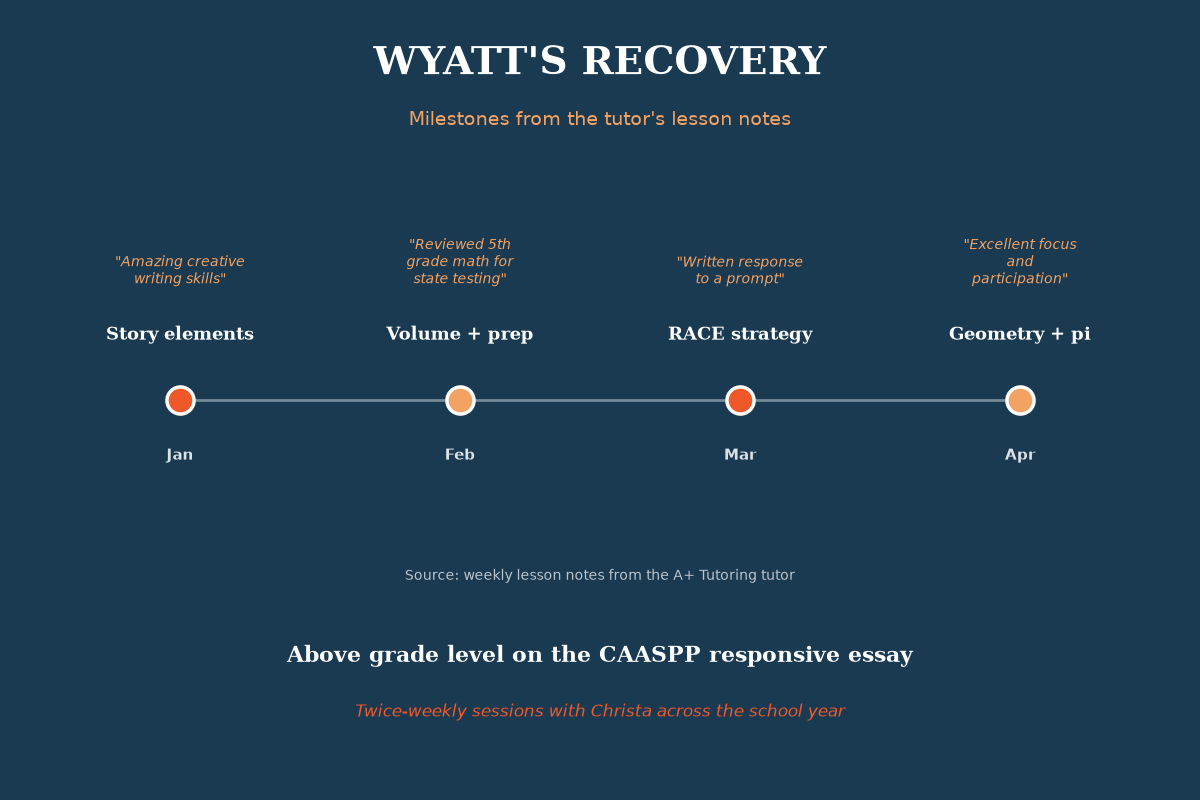
Over roughly a school year of twice-weekly sessions, Christa and Wyatt worked through an unusually wide slice of 5th grade math and ELA, and then some. The lesson notes from a single stretch of weeks include: volume of rectangular prisms, adding fractions with unlike denominators, converting cups to quarts, plotting points on a graph, PEMDAS, and defining and drawing the properties of ten geometric shapes side by side: square, pentagon, hexagon, trapezoid, rhombus, parallelogram, octagon, and the rest.
On the ELA side, Christa walked him through the RACE writing strategy (Restate, Answer, Cite, Explain), had him respond to prompts in full, worked on identifying text evidence and figurative language, and read multi-source passages on service animals so he could practice pulling from more than one text in a single response. She also gave him room to be a writer. One session note simply reads: "Wyatt has amazing creative writing skills." (The tutor's actual note; the student's name is anonymized in this story.) In another session they returned to a short story he was writing called "The Junk Bots" and mapped its plot, protagonist, antagonist, and theme onto the story elements he was learning.
Then there was pi. Christa introduced pi during a geometry lesson, a concept typically taught several grades later. Wyatt remembers exactly when it happened. "She first taught me pi," he said. "Then when I looked up after that tutoring lesson, like, you're supposed to learn pi, like, three grades above."
"I've learned a lot with Christa. She's helped me through literally everything I've needed to know in my grade and above." . Wyatt, 5th grade
The turning point
The moment everything shifted was the responsive essay.
Wyatt had never written one. His state test was coming. Christa didn't hand him a template. She drafted one alongside him, on a topic he could actually latch onto: an essay about Elvis Presley. She showed him how to hold a claim, how to pull evidence from a source, how to explain the evidence in his own words, how to close it. They did it together, and then he did it on his own.
When the CAASPP came, Wyatt sat down to the essay prompt and something new happened. "From then, I didn't even know how to write a responsive essay," he said. "But on the test, after she taught me, I felt like I knew it like the back of my hand."
He scored above grade level on that essay.
The outcome
The essay score is the headline, and it is a real one. A 4th grader who couldn't structure a responsive essay in the fall wrote an above-grade-level one on the state test in the spring. But the deeper outcome is the one Claudia watches every week at home.
Wyatt is now working ahead of his grade in multiple areas. He recognizes concepts on his charter school's online homework program before the program teaches them, because Christa taught them first. "Ninety-nine percent of the stuff that it teaches me on the computer," he said, "I learned first from Christa." He can hold his own on geometry vocabulary, on multi-step math word problems, on multiplying mixed numbers, and on writing tasks that used to shut him down.
The soft outcomes matter just as much. This is a homeschooled 5th grader who now describes tutoring as fun, who volunteered to get on a phone call with a stranger to talk about it, and who wraps that call by saying, unprompted, that Christa "should be assigned to at least every student."
"I would love for you guys to have these scores. To inspire more kids to use A+ Tutoring." . Wyatt, 5th grade
Where Wyatt is now
Wyatt is finishing his 5th grade year still working with Christa twice a week, moving between ELA and math, still building above his grade level. His mom is planning to keep the tutoring in place going into middle school, when the writing demands jump again and the math starts opening into pre-algebra: exactly the territory where a strong foundation, patiently built, pays off the most.
If your child is at grade level but not quite grasping it, or facing a state test with a skill they've never been directly taught, our team can talk through what's actually going on and whether A+ is the right fit for your family.
Talk to A+ About Your Child's Learning Plan
Learn more about how A+ builds a plan around each student on our services page, or, if you're a homeschool family like Wyatt's, our homeschool tutoring page walks through how the model works day-to-day.