.jpg?width=110&height=79&name=Hi-Res%20Logo%20%20(320%20%C3%97%20230%20px).jpg "Hi-Res Logo (320 × 230 px)")
.jpg?width=145&height=104&name=Hi-Res%20Logo%20%20(320%20%C3%97%20230%20px).jpg "Hi-Res Logo (320 × 230 px)")
A note on privacy: this is a real A+ Tutoring student's story, shared with their family's consent. Names and identifying details have been changed to protect their privacy; the tutor is named with permission.
The first sign her mother noticed wasn't a test score. It was the way Victoria talked about math at the dinner table.
"She started talking like math was a subject that she just struggles [with]," her mother, Yolanda, remembered. "It's not her subject anymore." This was new. For most of elementary school, Victoria had been the kid who got it — sometimes the kid teachers said could be working above grade level. Math had been a place where she felt smart. Now, as a 9th grader in a rigorous high school math course at a charter school in Southern California, Victoria was falling behind on assignments, watching her grade slip toward a D, and quietly stepping away from a subject she used to enjoy. Yolanda could feel it happening. The joy was gone, and the missed assignments were piling up faster than Victoria could catch them.
![Pull quote: She started talking like math was a subject that she just struggles [with].](https://blog.wetutorathome.com/hubfs/aplus-blog-images/pull-quote-s1-with-logo-2026-06-16-case-study-victoria.png)
What changed it wasn't a curriculum or a worksheet. It was a tutor — and a steady, week-after-week rebuild of the thing Victoria had lost first: her confidence.
When the joy goes quiet
Before the pandemic, Victoria had been a strong math student in public school. Then everything went online. Instruction got choppy. Assessments arrived before lessons had landed. Like a lot of students her age, Victoria started getting tested on material she hadn't fully learned yet — and the gap between what she knew and what she was being asked to do quietly widened.
By the time her family moved into homeschooling for a reset, the academic structure was better, but the emotional damage to her relationship with math was already done. Victoria stopped naming math as a favorite. She started naming it as the hard one.
By 9th grade, she was enrolled in a rigorous course at her charter school with daily assignments and an expert subject teacher she didn't grade with directly. Her facilitator, Sandra, was watching her grade carefully. Victoria was working hard. She just couldn't keep up alone.
The call that started it
What Yolanda wanted wasn't a quick fix. She'd been around education long enough to know quick fixes don't hold. What she wanted was someone who could sit with Victoria, find the specific places she was stuck, and address those — not just push her through the next assignment.
"Whatever she's questioning in the math, we get those addressed." That was the standard. Not "raise the grade." Find what's underneath the grade. When Yolanda reached out to A+ Tutoring, that's what she asked for: a person who could meet Victoria where she actually was.
What had already been tried
Yolanda had already done a lot of the work herself. During homeschooling, she'd taught Victoria directly, which meant she knew — with unusual precision — exactly which concepts were shaky and which ones were solid. She had the worksheets. She had the notes. What she didn't have was time and bandwidth to be Victoria's mother, her household manager, and her daily math teacher all at once, especially as Victoria moved into high school content.
The family had also tried other supports along the way. None of them had brought the joy back. None of them had given Victoria a person she actually wanted to show up for.
The match
A+ paired Victoria first with a tutor who was, by every measure, excellent — but not the right fit for her. Yolanda flagged it honestly, and the team responded the way she hoped they would: no defensiveness, no friction. They found someone else.
That someone else was Amelia G., the tutor Victoria still works with today.
What made the match work wasn't just Amelia's command of the math. It was how she handled the small, human parts of a session. Victoria is a social kid — she likes to ask how someone's day is going and have it answered. Amelia gave her that, then moved cleanly into the math without losing time or focus.
"They have a very good balance," Yolanda said. "She stayed on time, she stayed on subject, and she didn't spend more time stressing the subject than teaching it."
Yolanda could hear it from the other room. Sometimes laughter. Sometimes a quiet I got it. The sound of a kid who wasn't bracing anymore.
The work
The math itself was substantial. Over months of weekly sessions, Amelia walked Victoria through the foundation she'd been missing and then up into the high school content her course demanded.
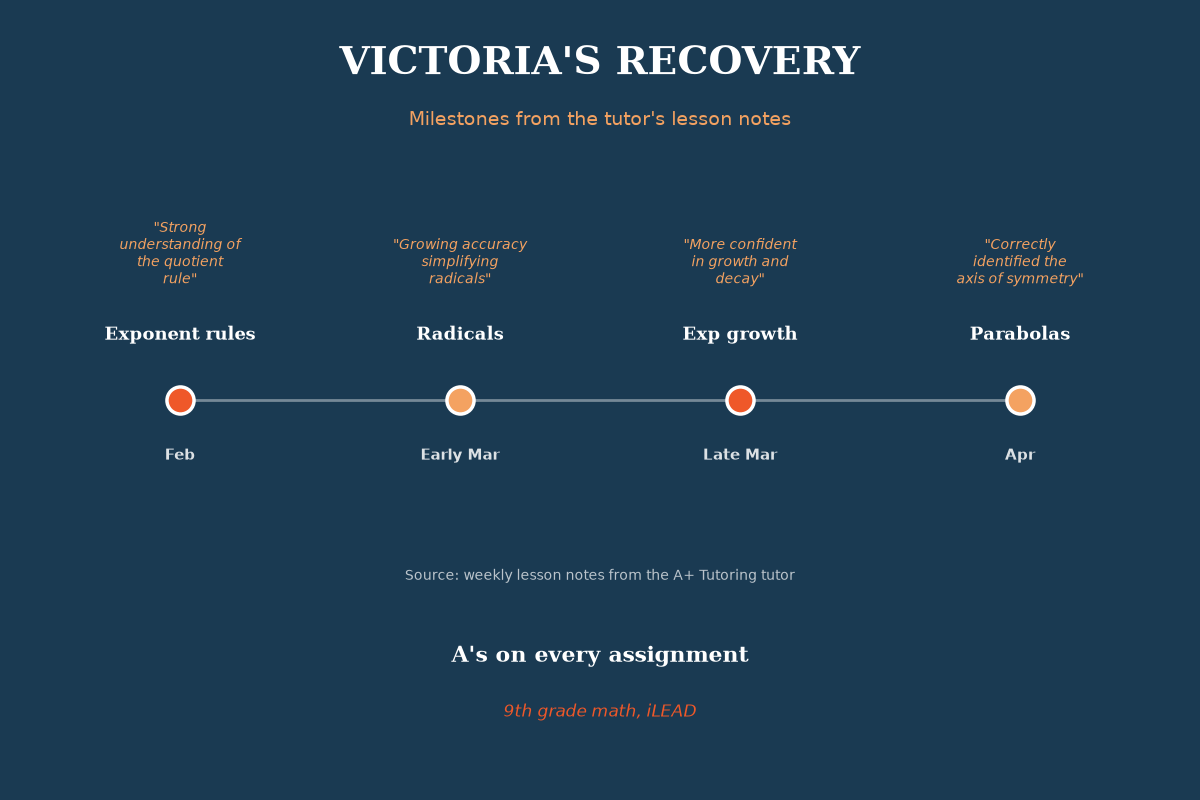
They started with exponent rules: the quotient rule for dividing like bases, coefficient reduction, the rules for rewriting negative exponents as positive. They moved into simplifying radicals, breaking numbers down into perfect-square factors, leaving answers in exact simplified radical form. They worked through how roots and powers cancel each other, when expressions resolve to rational versus irrational values, and how to read the structure of an equation rather than just memorize a procedure.
From there, Victoria stepped into the harder territory her class was actually in: identifying exponential growth versus decay from a table, writing exponential equations from patterns, and then quadratics. Parabolas, function notation, the axis of symmetry, using symmetry to extrapolate new points on a curve.
What Amelia did differently was small but enormous: when Victoria made an error, like squaring a negative incorrectly or missing a sign rule, Amelia didn't rescue her. She let Victoria work it out, asked her how she got there, and sometimes, when Amelia herself wanted to double-check, worked it out openly in front of Victoria too.
"They were humble enough to allow her to show them," Yolanda said. The message under the math was clear: mistakes aren't failure. Mistakes are how the work moves.
By the time Victoria was identifying the axis of symmetry from two symmetrical points on a parabola, correctly and independently, she was no longer the kid who said math wasn't her subject.
The turning point
Yolanda remembers the exact shift.
"I saw her joy kick in." It wasn't a single test. It was Victoria coming to her on a non-tutoring day with a question. Mom, I need help on this one. Willing to ask, willing to stay in the problem. The avoidance was gone. Math had stopped being the subject she dodged. It had become the subject she wanted to figure out.
Around the same time, Sandra, her facilitator, started noticing it from the school side: Victoria was talking about tutoring on her own. She was telling Sandra she'd been getting A's. She was telling Sandra she felt confident.
Where the numbers landed
Victoria's overall course grade is still climbing back from the early gap. She started at a D and is working her way to a C, with a clear path to passing before the end of the school year. But the leading indicator was already there in the daily work.
"Since she's been working with the tutor, all of her assignments she is earning an A on." — Sandra, Victoria's facilitator
A's on current assignments. A facilitator who expects her to pass. A subject teacher whose rigorous course Victoria is no longer drowning in. And, underneath all of it, a kid who is asking for help instead of hiding from the work.
Yolanda put it the way only a parent can:
"It may not seem like a lot of time, but the tutoring did more for her this school year than everything else."
Where Victoria is now
Victoria is still working with Amelia weekly. The current sessions are deep in quadratics: function notation, parabolas, symmetry, the connections between linear, quadratic, and exponential functions. She'll be taking MAP testing in the coming weeks, and her facilitator expects her math score to reflect what the assignment grades are already showing.
More importantly, Victoria is the one driving it now. She asks for her tutors by name. She brings her own questions to sessions. She is no longer a student who needs math done to her; she is a student doing math.
If your child once loved a subject and somewhere along the way stopped, if the grades are sliding and the confidence is sliding faster, that gap is closeable. It takes the right person, a steady cadence, and a real plan. Our team can talk through what's actually going on with your child and what a plan might look like.
Get Your Child the Support They Need
Learn more about how A+ tutoring works or read about another student's turnaround in math.