.jpg?width=110&height=79&name=Hi-Res%20Logo%20%20(320%20%C3%97%20230%20px).jpg "Hi-Res Logo (320 × 230 px)")
.jpg?width=145&height=104&name=Hi-Res%20Logo%20%20(320%20%C3%97%20230%20px).jpg "Hi-Res Logo (320 × 230 px)")
Spring NWEA MAP reports landed on charter directors' desks this week in 18,000+ schools. Most directors will glance at the proficiency summary and file the report until September. A small minority will sit down for one afternoon, work through the report systematically, and walk out with a named list of 10-30 students who need Tier 3 intervention next year. That list, built in May, is what separates charter LEAs that move outcomes from charter LEAs that explain why outcomes didn't move.
This piece is the protocol. It is the operational companion to last week's argument that the 21-day window between MAP closing and summer staffing locking is the highest-impact intervention decision of the year. Last week answered when. This week answers how, in five steps, in about three hours.
What the Spring MAP Report Actually Contains
A standard NWEA MAP Growth report includes seven views that matter for cohort design. Most directors open three. The other four are where the cohort lives:
- District / School Summary: proficiency band breakdown. Useful for the board slide, not for cohort design.
- Grade-Level Summary: proficiency by grade. Shows where the gaps cluster.
- Class Breakdown: proficiency by teacher / class. Instructional planning, not Tier 3.
- Student Growth Summary: every student's fall-to-spring growth in RIT points. First view with named students. Bottom 15% by growth is the candidate pool.
- Subgroup View: same data filtered by IEP, EL, and free / reduced lunch status. Where the cohort starts to take shape.
- Projected Proficiency View: NWEA's prediction based on current growth trajectory. Students projected to fall short despite "on level" status are the silent emergency.
- Within 5 Points Callout: students within 5 RIT points of the next proficiency band. The 5-points-below group is your highest-ROI Tier 3 cohort.
Most charter directors will not have opened views 4 through 7. Those four views are the protocol.
The Five-Step Protocol
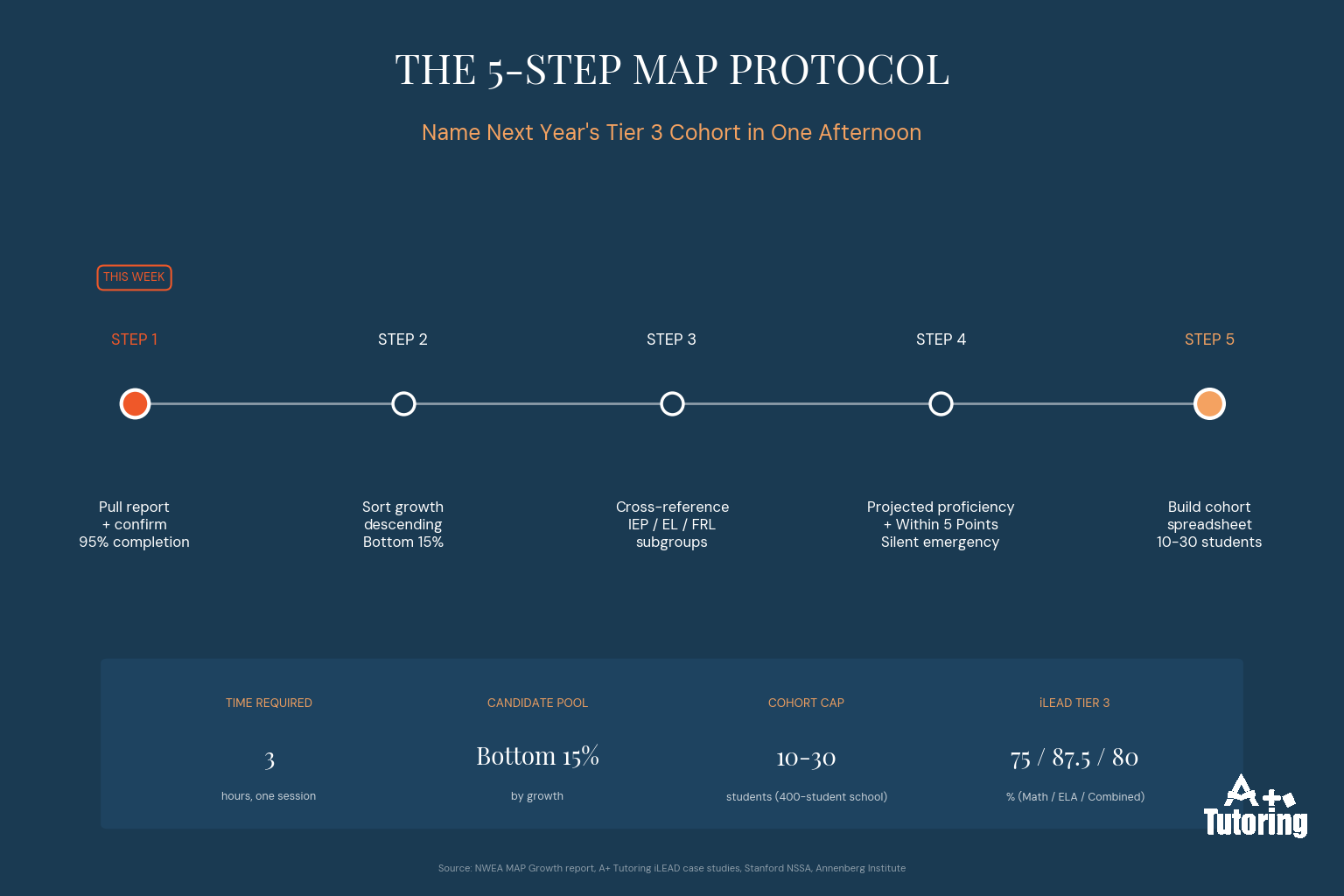
For the next three hours, a charter director with a spring MAP report and a notepad can build the named Tier 3 cohort for next year. Five steps:
Step 1. Pull the report and confirm assessment-window dates
Confirm with the assessment coordinator that 95%+ of enrolled students completed the spring assessment. If completion is under 90%, the absentees are likely the students who would have been in the cohort. Flag and proceed with a footnote.
Step 2. Open the Student Growth Summary view and sort by growth descending
The bottom 15% of growth (the students who grew less than expected from fall to spring) is the candidate pool. For a K-8 charter with 400 students, that's 60 students.
Reflection question for the reader: If the candidate pool is 60 students, how many of those 60 are already in the school's existing Tier 2 or Tier 3 service? If the answer is "fewer than 20," the school is identifying need but not addressing it.
Step 3. Cross-reference the candidate pool with IEP, EL, and free / reduced lunch status
In the Subgroup View, filter for students with active IEPs. Then for students currently classified as English learners. Then for students on free / reduced lunch. Mark students who appear in two or more subgroups; those are the students whose intervention need is most likely to compound across years.
Annenberg Institute's tutoring research is consistent on this point: the lowest-performing students who are also in multiple flagged subgroups show the largest effect sizes under high-impact tutoring conditions. The cross-reference is not just diagnostic; it predicts which students will respond most to a well-designed Tier 3 block.
Step 4. Open the Projected Proficiency and Within-5-Points views to find the silent emergency
Sort the Projected Proficiency view for students projected to fall short of state proficiency by next spring DESPITE currently showing "on level." They are flying under the radar because the snapshot looks fine; the trajectory does not.
Then the Within-5-Points view. Students 5 points below the next cutoff are the highest-ROI Tier 3 candidates: a focused 18-24 hour summer block can move them across the band.
Reflection question for the reader: When did you last hear from the assessment coordinator about the "students within 5 points" group? If never, the report is doing its job and the school is not.
Step 5. Build the cohort document and name the students
Open a spreadsheet. Columns: Student name, grade, current Tier (1 / 2 / 3 / none), spring RIT (Math + ELA), growth percentile, IEP status, EL status, projected proficiency, recommended summer block (Math / ELA / Both / None).
Filter the candidate pool from Step 2 (bottom 15% growth) plus the silent-emergency students from Step 4 (projected to fall short). Cap the cohort at 30 students for a 400-student charter. Tier 3 is targeted, not universal. Cap at 50 for a 1,000-student charter.
The cohort document is the artifact. Bring it to leadership. Bring it to the tutoring-vendor procurement conversation in June. Bring it to the board meeting in July. It is the named, evidenced, defensible answer to "who needs the intervention next year."
What the Research Says About This Protocol
Susanna Loeb's work at Stanford's National Student Support Accelerator finds that high-impact tutoring effect sizes (0.20-0.40 standard deviations) concentrate when the cohort is defined ex-ante from assessment data rather than ex-post from teacher referral. The Annenberg Institute's tutoring meta-analysis reaches a parallel conclusion across 96 studies.
Linda Darling-Hammond, President of the California State Board of Education, has framed this in policy terms. As she has put it, "Data identifies the students. Architecture moves them." The MAP report identifies. The protocol above is the architecture for identification; dosage architecture (same tutor, 18-24 hours, MAP-aligned content) is what comes next.

What A+ Sees in the Field
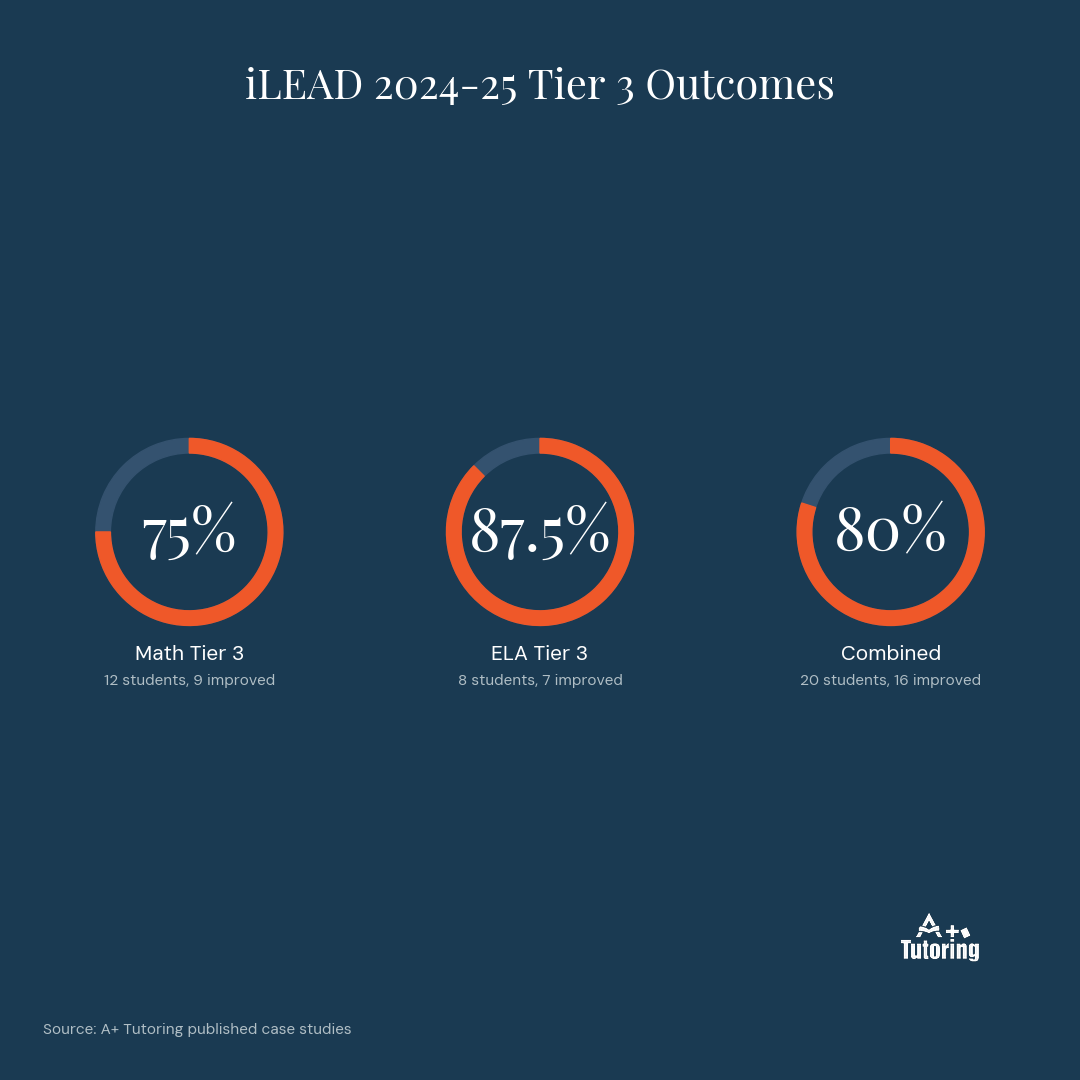
A+ Tutoring partner schools running the protocol above produce Tier 3 outcomes consistent with the Annenberg and NSSA findings. The published iLEAD case studies are the worked example: the Math Tier 3 cohort (12 students) showed 75% reaching MAP growth benchmarks. The ELA Tier 3 cohort (8 students) showed 87.5%. The combined Tier 3 cohort (20 students) showed 80%, at 3-6x national MAP Growth benchmarks for the lowest-quartile population.
Reflection question for the reader: If your school's spring MAP report were closed tomorrow, do you know who the bottom 15% of growth students are?
The protocol does not require a tutoring vendor; it requires three hours of focused reading. The cohort that emerges is the artifact that drives every procurement, staffing, and intervention decision for next year.
What School Leaders Can Do Next
For charter directors and special programs coordinators reading this in the last 7-10 days of May, five steps complete the protocol by June 5:
- Block three hours on the calendar this week. Not next week. The reports are fresh now; the cohort decisions need to drive summer staffing decisions that lock in early June.
- Pull the seven views listed above in one session. Don't try to do this in 15-minute increments; the cross-referencing only works in a single continuous session.
- Build the cohort spreadsheet by Friday. Named students, columns for each indicator, recommended summer block per student.
- Walk the spreadsheet with the assessment coordinator on Monday. A second pair of eyes catches misclassifications. The assessment coordinator will also know which students are leaving the school next year (and therefore should NOT be on the cohort).
- For administrators and federal program coordinators: map each cohort student to the funding line that will pay for their intervention next year. Title I Part A and Title III LEP are the most common lines; state special education funding is another. The cohort spreadsheet plus the funding mapping is the documentation that holds up to any compliance review and is the basis for the 2026-27 budget conversation in June board meetings.
The work fits inside one focused afternoon. The cohort that emerges names the students whose growth trajectory the school will be defined by next year.
About A+ Tutoring
A+ Tutoring is a California K-12 virtual intervention provider working with charter LEAs and funded intervention programs. We run Tier 2 and Tier 3 tutoring at the dosage and consistency the NSSA evidence base calls for. See the published case studies for the iLEAD Math Tier 3 cohort and iLEAD ELA Tier 3 cohort, our partner iLEAD Exploration, and our services page.
A+ partner schools have shown 75% of Math Tier 3 students reaching MAP growth benchmarks, 87.5% in ELA Tier 3, and 80% in the combined Tier 3 cohort, at 3-6x national MAP Growth benchmarks.