.jpg?width=110&height=79&name=Hi-Res%20Logo%20%20(320%20%C3%97%20230%20px).jpg "Hi-Res Logo (320 × 230 px)")
.jpg?width=145&height=104&name=Hi-Res%20Logo%20%20(320%20%C3%97%20230%20px).jpg "Hi-Res Logo (320 × 230 px)")
A note on privacy: this is a real A+ Tutoring student's story, shared with their family's consent. Names and identifying details have been changed to protect their privacy; the tutor is named with permission.
Noah is a 6th grader at a charter school in California. At the start of this school year, his i-Ready math diagnostic placed him at a 5th grade level, a full year behind where he needed to be. By his teacher's account, the gap wasn't closing. By his mother's account, math was the subject he openly hated. By Noah's own admission, math was his worst subject, and he said so out loud, often. Six months later, Noah's i-Ready placement had climbed into the early 6th grade range across three of four math domains, his mom describes him as someone who now looks forward to math, and his tutor Hannah T. closed out the school year by handing him a certificate he was, in his mother's words, "genuinely excited about." This is the story of how that shift happened.
The kitchen-table problem
The scene at home before tutoring was familiar to any parent of a kid who has decided a subject is not for them. Noah would sit down with his math homework and wait. He wasn't trying. He wasn't fighting. He was just stalling, watching his mom out of the corner of his eye, hoping she would eventually give him the answer so he could move on. His mom, Gloria, knew it. "He didn't really wanna put much effort into it," she said. "He really didn't like math at all. It was his worst subject. He literally would say that."
Math wasn't just hard. It had become an identity. Noah had decided he was a kid who was bad at math. And once a sixth grader has decided that about themselves, the homework battle stops being about fractions or coordinate planes. It becomes about a story the kid is telling about who he is.
The call from the school
The triggering moment wasn't a single tear or a single failed test. It was a pattern on a printed report. Noah took his i-Ready math diagnostic in the fall and placed at Grade 5. He took it again at the mid-year benchmark, and the result was identical. Same placement. Same gap. No movement.
For Gloria, that mid-year report was the moment. The school had been the one to flag it first. Noah's teacher recommended a tutor. But the report made it concrete. Two diagnostics, six months apart, and the needle hadn't budged. Whatever Noah was getting at school wasn't enough. Whatever Gloria was doing at the kitchen table wasn't enough either. Something had to change before the end of 6th grade, because 7th grade math was coming and it wasn't going to wait.
What had been tried already
Before A+, the support plan looked like most family support plans do. Gloria sat with Noah during homework. The school provided classroom instruction and the i-Ready platform itself. Noah's teacher flagged the lack of progress. None of it was wrong, exactly. It just wasn't moving him. The i-Ready report card listed Noah's strengths (he had solid quantitative reasoning and decent number sense) right next to his gaps (multi-digit decimals, fractions, ratios, geometry). But a list of gaps isn't a plan. A 6th grader who has decided he hates math isn't going to close that list on his own, and a parent helping at the kitchen table can't deliver targeted, sequenced intervention session after session. That's what the school recognized, and that's what prompted the recommendation.
The match with Hannah
A+ matched Noah with Hannah T. for weekly one-on-one math tutoring. The plan was specific: target the three i-Ready domains where Noah was furthest behind: Number and Operations, Algebra and Algebraic Thinking, and Measurement and Data. Rebuild his confidence as a math student in the process.
The first sessions told Hannah everything she needed to know. Noah was quiet. Noah was watchful. Noah was waiting to be told what the right answer was so he could write it down and be done. Hannah refused to play that game. Instead of feeding him answers, she asked him to walk her through his thinking, one step at a time. When he got stuck, she modeled. When he tried, she let him try. When he caught his own mistake, she let him correct it without rushing in. Gloria noticed the change almost immediately. "She allowed him to really think out, like, how to do the problem," Gloria said. "Before tutoring, it was more like he was waiting for me to give him the answer."
That single shift, from waiting for the answer to working through the problem, was the foundation everything else got built on.
The work, week after week
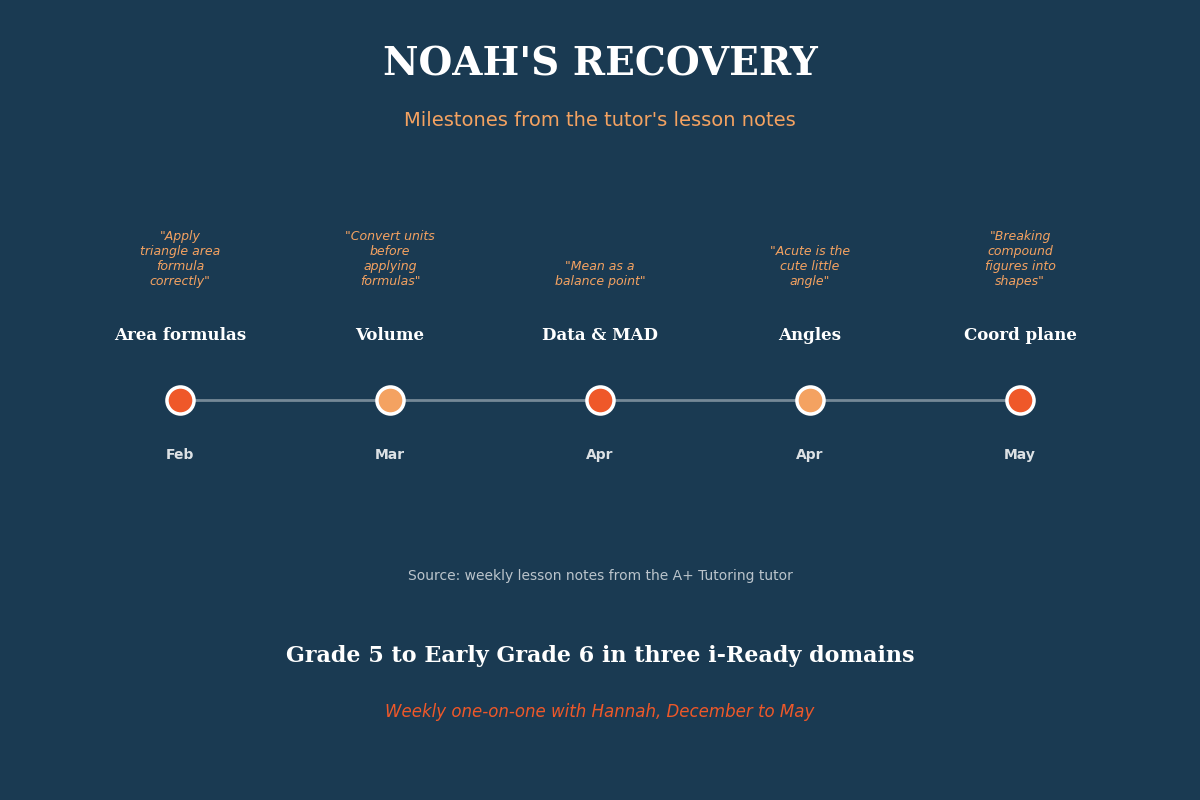
Over the next several months, Hannah and Noah worked through the actual curriculum Noah was facing in class. They tackled operations with decimals, lining up place values and catching the small errors that had been costing him whole problems. They moved into mean, median, mode, and the five-number summary, using real-world rainfall data so the numbers meant something. They built up to surface area and volume of prisms and pyramids, where Noah had to convert units before applying formulas. Exactly the kind of multi-step problem he used to bail on. They worked on the coordinate plane, area of compound figures, and angle relationships in triangles and quadrilaterals.
Hannah's session notes show a tutor doing real teaching, not test prep. When Noah couldn't keep "acute," "right," and "obtuse" straight, Hannah gave him a mnemonic: acute is the "cute" little angle, right is shaped like a capital L, obtuse is the wide one. He stopped mixing them up. When a multi-step word problem stalled him, Hannah modeled the decomposition out loud, then handed him the next one and let him try. He started self-correcting before she had to prompt him.
"She allowed him to really think out, like, how to do the problem. Before tutoring, it was more like he was waiting for me to give him the answer." — Gloria, Noah's mother
Gloria stayed in the loop the whole time. Scheduling happened by text, which made changes painless. After every session, Hannah sent a recap email covering what they had worked on, what the California standards were, what Noah had nailed, and where he still needed practice. Gloria could see exactly what was happening without having to be in the room.
The turning point
The shift wasn't a single tearful moment. It was a sentence Noah started saying out loud at home. After weeks of working with Hannah, Gloria noticed he had stopped complaining about math homework. Then she noticed something stranger: he was looking forward to it. He'd pull out his math work without being asked. He'd try a problem before waiting for help. The kid who had spent the first half of 6th grade announcing that math was his worst subject just stopped saying it. "He now, like, looks forward to doing math," Gloria said. "He feels like it's a lot easier to do. Like, he feels like he's able to think out how to do the problems now." That was the 180.
What the data says
In December, Noah's i-Ready math diagnostic placed him at Grade 5 across the board: Number and Operations, Algebra and Algebraic Thinking, Measurement and Data, and Geometry all at Grade 5. Overall scale score: 484. National norm: 50th percentile, but at a 5th grade placement for a 6th grader.
By the April diagnostic, after months of weekly work with Hannah, Noah's overall scale score climbed to 491, and three of his four domains moved up into Early Grade 6 placement: Number and Operations (494), Algebra and Algebraic Thinking (505), and Measurement and Data (498). Geometry was the one domain that didn't move, and there's a reason for that. Hannah and Noah hadn't gotten to geometry in their sequence until after the April test. In the weeks following, they hit angles, coordinate-plane area, compound figures, prisms, and pyramids hard. Gloria expects that gain to show up on the fall benchmark.
"He drastically improved in math. From him saying math is his worst subject, getting frustrated with math work, and math concepts not clicking, to now, he looks forward to math and grades drastically improved — all thanks to Hannah, his tutor. She's amazing!" — Gloria, Noah's mother
Asked how likely she'd be to recommend A+ Tutoring on a scale of zero to ten, Gloria didn't hesitate. "Oh, definitely a ten, for sure."
Where Noah is now
Noah finished the school year with Hannah, certificate in hand, and Gloria has already told us he wants to come back next year. He's heading into 7th grade with a math placement that's almost on grade level, a tutor who knows how he thinks, and, more importantly, a different story about himself. He's no longer the kid who says math is his worst subject. He's the kid who looks forward to it.
If your child is below grade level in math and the school's interventions aren't producing results, our team can talk through what's actually going on.