.jpg?width=110&height=79&name=Hi-Res%20Logo%20%20(320%20%C3%97%20230%20px).jpg "Hi-Res Logo (320 × 230 px)")
.jpg?width=145&height=104&name=Hi-Res%20Logo%20%20(320%20%C3%97%20230%20px).jpg "Hi-Res Logo (320 × 230 px)")
A note on privacy: this is a real A+ Tutoring student's story, shared with their family's consent. Names and identifying details have been changed to protect their privacy; the tutor is named with permission.
The first time Isabella tried to explain a reflection across the x-axis to herself, she froze. She knew the shape had to flip. She knew the numbers had to change. But which number changed? Did the x get negated, or the y? She erased her pencil marks, tried again, erased them again. By the time she finished the problem, she wasn't sure her answer was right. And she wasn't sure how to check.
This was Isabella in 9th grade, working through pre-algebra concepts that had started to pile up faster than she could catch them. She wasn't failing. Her grades were, in her own words, "average." But average felt like standing still while the class moved forward, and the gap between what she could do confidently and what she was being asked to do was widening every week.
Her mother noticed. Homework was taking longer. Isabella was second-guessing herself on problems she should have been able to do. And the kind of tension that shows up at kitchen tables when a kid feels behind, the kind every parent recognizes, was starting to settle in.
The Call to Action
Isabella's mom reached out to A+ Tutoring after realizing something a lot of parents realize at exactly this point in their child's education: 9th grade math isn't the place to let a shaky foundation slide. High school math builds on itself relentlessly. Linear equations become systems. Systems become functions. Functions become everything.
She told the A+ intake team that Isabella needed more support than she was getting at school, and that schoolwork was starting to lead to frustration at home. She wasn't looking for a miracle. She was looking for someone who could actually sit with Isabella, figure out where the confusion was, and help her build the pieces back up.
The Search for Solutions
Like most parents in this situation, Isabella's mom had already tried the obvious things. Encouraging Isabella to ask her teacher for help. Working through problems together at home. Watching video explanations. The problem wasn't a lack of effort. It was that Isabella needed someone who could slow down, notice which specific step lost her, and stay on that step until it clicked.
That's a hard thing to get in a classroom of thirty students. It's a hard thing to get from a parent who last saw pre-algebra twenty years ago. And it's a hard thing to get from a video, which can't tell when you nodded but didn't actually follow.
Isabella needed a person. She needed patience. And she needed someone who could teach math without making her feel behind for asking.
The Match
A+ paired Isabella with Gianna C., a math tutor known for meeting students exactly where they are and building forward from that spot, not from where the textbook thinks they should be.
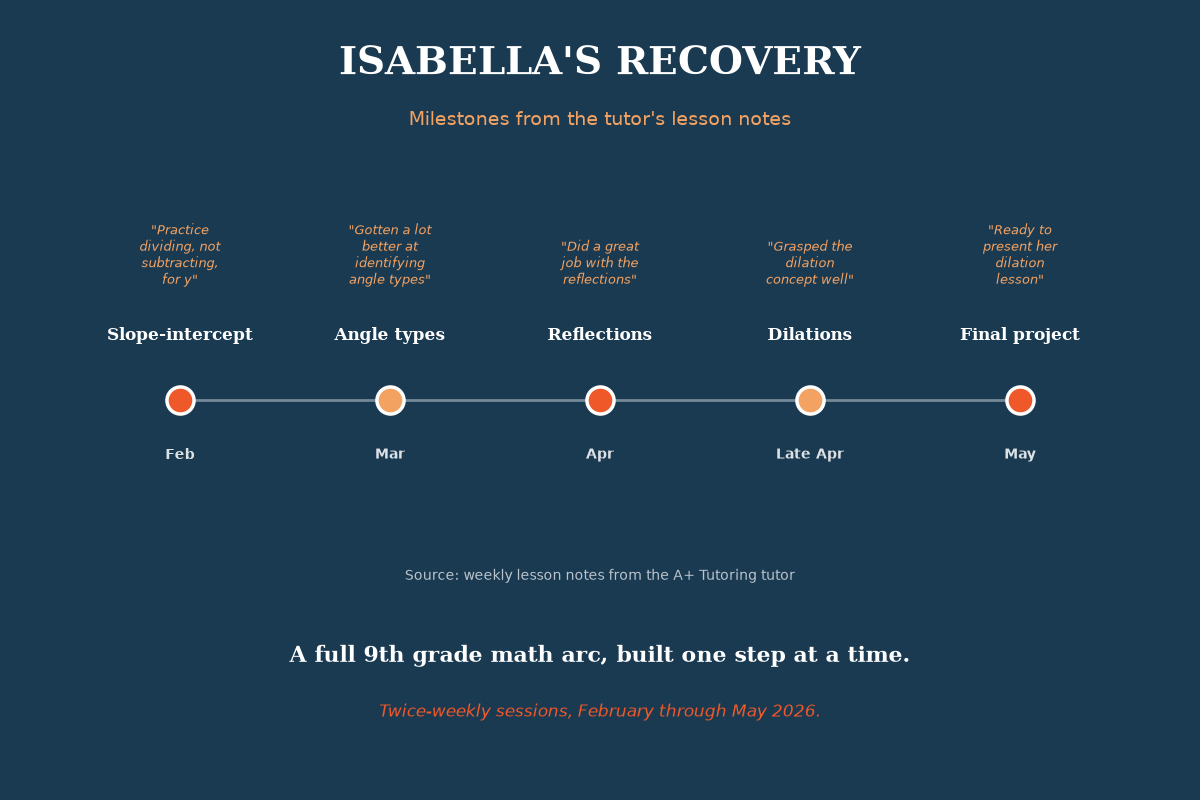
Their first sessions focused on the pieces of pre-algebra that were quietly holding everything else back: converting linear equations from standard form to slope-intercept form, and, the exact place a lot of 9th graders get stuck, remembering to divide, not subtract, when isolating y. That distinction is small on paper and enormous in practice. Get it wrong, and every graphing problem afterward looks impossible. Get it right, and a whole unit of math suddenly makes sense.
Gianna didn't rush her. When Isabella didn't understand a concept the first time, Gianna reframed it, gave her a second example, and let her work through it at her own pace. The atmosphere was the opposite of the one Isabella had been carrying into her homework: no pressure, no embarrassment, no clock.
"She was really nice, and she was quite patient with me — even when there were some times when I wasn't able to understand the concept right away. With the patience, I was able to understand it and get really better at algebra." — Isabella, 9th grade student
The Work
Over the course of the program, Isabella and Gianna worked through a full arc of 9th grade math content. Twice a week, session after session, building on itself the way the curriculum is supposed to build but rarely gets the chance to.
They started with linear equations and graphing. Isabella practiced converting between forms until slope-intercept stopped feeling like a foreign language. They moved into inequalities: solving them, graphing the solutions, understanding what the shaded region actually meant. When she got stuck on multi-step problems, Gianna kept reinforcing the same core habit: combine like terms first, then use inverse operations to move things across the equals sign.
Then came angles. Vertical, adjacent, complementary, supplementary. Isabella learned to identify the pair, set up the correct equation, and solve for the missing value. Gianna's session notes from March mark the shift plainly: "Isabella has gotten a lot better at identifying angle types. Great job today!"
From there they went into the Pythagorean theorem, and then into the heart of 9th grade geometry: transformations. Reflections across the x-axis and y-axis. Translations. Rotations of 90°, 180°, and 270° counterclockwise about the origin. Dilations, scale factors, and centers of dilation.
By the final sessions, something remarkable happened. Isabella wasn't just solving transformation problems. She was preparing to teach one. Her final project asked her to present a lesson to her class, and she chose dilations. She and Gianna worked on lesson planning: how to structure the concept, how to build a clean example, how to explain the transformation process in her own words so that other students could follow it.
The student who six months earlier had been second-guessing her reflections was now designing a lesson on dilations for her peers.
The Turning Point
The moment it clicked came somewhere in the middle of the transformations unit. Isabella was working through a reflection problem, the same kind of problem that used to make her erase and start over, and she just did it. No hesitation. No checking the answer three times. She wrote the coordinates, moved to the next problem, and kept going.
"Before, I wasn't really able to understand how to do reflections. After the tutoring, I can almost do them without second-guessing my answer." — Isabella, 9th grade student
That's the sentence every parent of a struggling math student is waiting to hear. Not "I got an A." Not "I love math now." Just: I don't second-guess myself anymore.
The Outcome
The grades followed the confidence, as they almost always do.
Before tutoring, Isabella described her math grades as "average." After working with Gianna, she reports earning B's, B+'s, and A's in her math class. A full letter-grade improvement, sustained across a semester of increasingly difficult content. Her mom, filling out the family's feedback survey, noted that Isabella is now more willing to take on challenges, talks more positively about school and learning, and has become more independent and self-driven in how she approaches her work.
The tension around homework that had prompted the family to reach out has eased. Isabella works more independently. When she gets stuck, she has strategies (combine like terms, check the operation, work backward from the answer) that she didn't have before.
"It was a pleasure having Gianna as our tutor." — Isabella's parent
Where Isabella Is Now
Isabella just finished her final tutoring session with Gianna, and she finished it by teaching. Her dilation lesson is ready to present. The concepts that used to make her freeze are now concepts she can explain to someone else, which is the truest test of whether a student really understands something.
She's heading into the next stretch of high school math with a foundation that's actually solid, habits that hold up under pressure, and the quiet confidence that comes from knowing she can figure things out. A+ is here whenever her family wants to add support again, for a new topic, a tough unit, or the jump into geometry and Algebra 2.
If your child is working below where you know they can be in math, our team can talk through what's actually going on and whether A+ is the right fit for your family. Learn more about how A+ tutoring works or read another family's story in our iLead Tier 3 math case study.