A note on privacy: this is a real A+ Tutoring student's story, shared with their family's consent. Names and identifying details have been changed to protect their privacy; the tutor is named with permission.
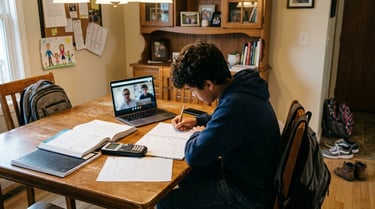
For most of 10th grade, Charlotte would sit down at the kitchen table, open her geometry packet, and start to cry. Not every day. But enough days that her mother, Adriana, learned to brace for it. The tears were not about one bad grade. They were not about one hard problem. They were about the whole subject. Geometry had become a wall, and Charlotte had stopped trying to climb it.
Then, over a few months of weekly tutoring with Gianna C., something shifted. Charlotte went from crying over math packets to scoring well on her most recent program assessment. Her mother describes it simply: "Everything just kinda started making sense." This is the story of how a 10th grader at a charter school in Southern California stopped avoiding math and started solving it.
The homework that wouldn't get done
Charlotte is a 10th grader enrolled at a California-based independent-study charter school, which means her mother is more involved in her coursework than most parents of high schoolers. Adriana saw everything up close. And what she saw, through most of the geometry year, was a kid who was quietly falling behind. Not because she wasn't smart, and not because she wasn't trying, but because the material had stopped making sense somewhere around proofs and parallelograms, and no one had slowed down enough to help her catch back up.
"Throughout the whole year, she struggled a lot in math," Adriana said. "We didn't have that problem last year. But geometry was just really confusing and complicated. It got to the point where she was getting frustrated every single day. And she wouldn't do it. Every day, for that same reason — just because she was so frustrated."
The worst part, Adriana said, wasn't even the time Charlotte spent on math. It was the time she spent avoiding it.
When the stress became bigger than the subject
By late winter, the real problem wasn't geometry. It was the dread of geometry.
"It was very stressful for her. Not even when she was working on math — just the fact that she knew that she had to work on math, it would start to stress her out, because she didn't understand it." — Adriana, Charlotte's mother
That is the moment a lot of parents recognize. The homework packet sitting unopened. The quiet "I'll do it later." The way a kid stops asking questions in class because they are tired of being the one who doesn't get it.
Adriana reached out to A+ because she had hit the limit of what she could do from the kitchen table. "I'm the worst when it comes to math," she said, laughing. "So knowing that I wasn't able to help her, just because I can barely understand it myself — I knew she needed someone else." She wanted a tutor who could meet Charlotte where she actually was: a shy student who had stopped volunteering questions, and who needed someone patient enough to earn her trust before the real work could begin.
What had already been tried
Before A+, the plan had been the standard plan. Charlotte had her charter school curriculum. She had her mother at the table. She had the resources her independent-study program provided. On paper, there was support in place.
In practice, none of it was closing the gap. Her mother could not teach geometry she had never understood herself. The curriculum moved forward whether Charlotte was ready or not. And the harder Charlotte tried to push through on her own, the more the frustration cycle took over. Avoid the work, fall further behind, feel worse, avoid more.
What Charlotte needed wasn't more content. It was someone to sit with her inside the content, slowly, until it clicked.
The right tutor, the right pace
A+ matched Charlotte with Gianna C., a tutor whose approach is built around something Adriana noticed almost immediately: Gianna refused to move on until Charlotte actually understood.
"Maybe it was the way that she was explaining it to her," Adriana said. "Or maybe it was the fact that they were going over the stuff just to make sure she was understanding it. Gianna would actually ask her, do you understand it? And she would say, yeah, it makes sense, before moving on."
For a student who had spent months quietly nodding through confusion, that single habit (pause, check, confirm, then move) was the thing that reopened the door.
Gianna also offered something Charlotte did not expect: access between sessions. "She would offer to email her even on the days that they weren't meeting, if she got stuck on something else," Adriana said. "Charlotte never actually emailed her, because once they did the lesson, it just made sense. But just the fact that she offered, that was really nice." It also sent a quieter message to a shy student: you are supported, not just on Tuesday and Thursday. All week.
The work: proofs, polygons, and slowly building back trust
From February through May, Charlotte and Gianna worked through the harder half of a standard geometry sequence twice a week. Session notes trace the arc clearly.
They started in the thorny territory of indirect proofs, the Triangle Inequality Theorem, and the Exterior Angle Inequality Theorem. These are exactly the topics where students stop believing math is something they can do. Charlotte, Gianna noted, "understood the postulates that were introduced and was able to apply them well."
From there they moved into quadrilaterals: trapezoids, isosceles trapezoids, parallelograms, and the three different methods for proving a quadrilateral is a parallelogram. Then into polygons more broadly: sums of interior angles, exterior angles, perimeter formulas, regular polygons. By late April they were into similar figures, scale factors, and real-world applications: comparing side ratios of parallelograms (15/10 = 1.5 and 18/12 = 1.5), and working a problem about a basketball hoop by converting 10 feet to 120 inches and finding the ratio of hoop height to ball height (120/9.39 ≈ 12.78).
Alongside the new material, Gianna kept circling back to Charlotte's weaker foundations: solving linear equations, multi-step equations, and the logic underneath proofs (converse, inverse, contrapositive). Not as punishment, but as repair. The point wasn't to cover more. The point was to make sure the ground underneath Charlotte was solid before building the next floor.
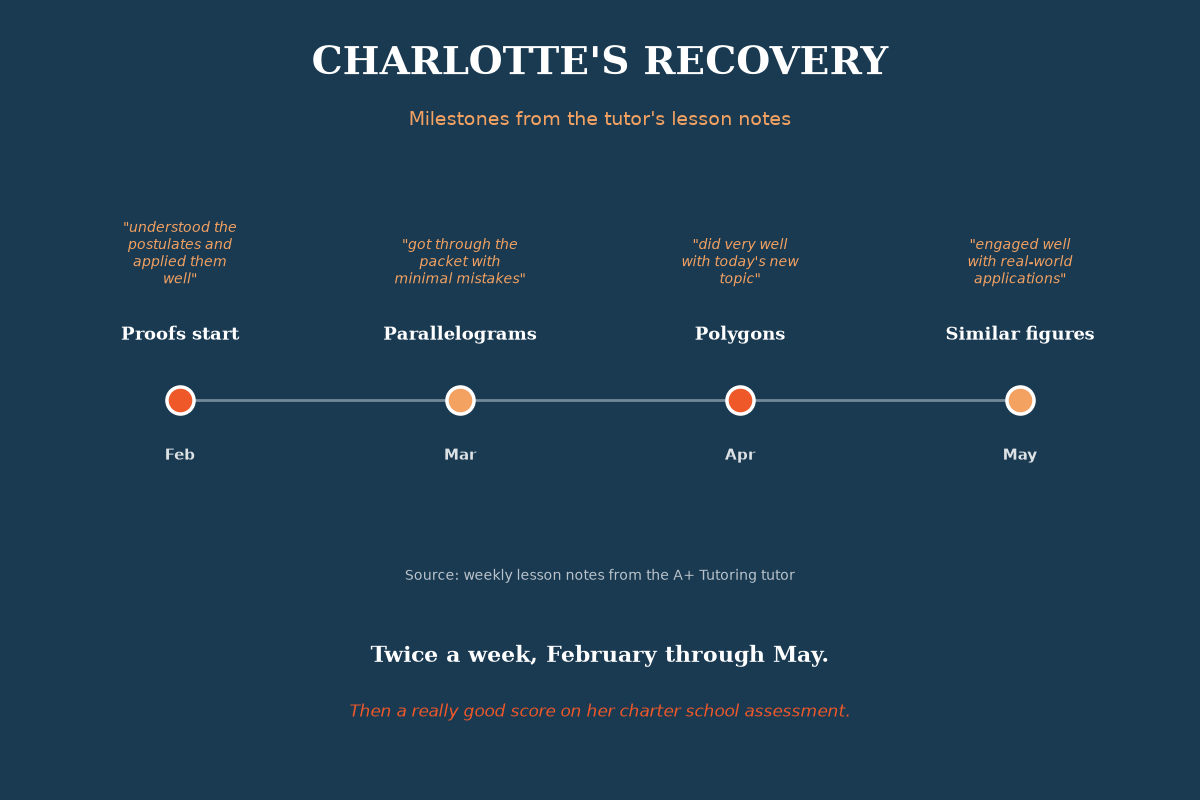
Over and over in the notes, the same quiet phrase appears: Good job today. Great job today. She did very well.
The moment it clicked
The turning point didn't come from one dramatic session. It came from the realization, several weeks in, that Charlotte had stopped bracing herself before math.
The crying stopped. The avoidance stopped. The packets started getting done. Not perfectly, not without effort, but done, in the normal way homework is supposed to get done. "She still struggles here and there," Adriana wrote in her survey, "but she understands better and is able to solve the problems."
For a parent who had watched her daughter dread this subject for months, that sentence is enormous.
The outcome: a real score, and a changed relationship with math
The hard data arrived on Charlotte's most recent math assessment inside her charter school's program. Adriana's description was short and happy: "On her last test, she got a really good score."
The softer data is just as real. Charlotte, who used to shut down in front of math, now sits down and works. She is more willing to take on challenges. She is more independent. The daily tension at home around schoolwork, the piece that had quietly been eroding her confidence, is gone.
"When she started with Gianna, everything just kinda started making sense." — Adriana, Charlotte's mother
Her mother credits the match itself. "She really liked Gianna. At first she was a bit shy to ask questions — that's just how Charlotte is. But she was able to really work with her and ask her questions. The feedback I got from her was, she really liked the way Gianna explained things. Gianna was just a really awesome help to have."
Where Charlotte is now
Charlotte is finishing out her 10th grade geometry work with a tutor she trusts, a subject that no longer scares her, and a mother who has her evenings back. Adriana has already told A+ she plans to come back if Charlotte needs support next year. That is the quiet highest compliment a parent can give.
If your teenager is avoiding math homework the way Charlotte was, not because they're lazy, but because the material has gotten away from them and the frustration is louder than the subject, that pattern is fixable. It usually takes the right tutor, consistent sessions, and someone willing to slow down and actually check for understanding before moving on.
Talk to A+ About Your Child's Math Plan
Learn more about how A+ tutoring works or, if your family is in an independent-study or charter model like Charlotte's, see our homeschool tutoring page.