.jpg?width=110&height=79&name=Hi-Res%20Logo%20%20(320%20%C3%97%20230%20px).jpg "Hi-Res Logo (320 × 230 px)")
.jpg?width=145&height=104&name=Hi-Res%20Logo%20%20(320%20%C3%97%20230%20px).jpg "Hi-Res Logo (320 × 230 px)")
A note on privacy: this is a real A+ Tutoring student's story, shared with their family's consent. Names and identifying details have been changed to protect their privacy; the tutor is named with permission.
1. The Status Quo
The crying started before the pencil ever touched the paper.
Lily, a 10th grader at a charter school in Southern California, had always been a steady math student. Then geometry hit. Proofs, parallelograms, interior angles, converse and contrapositive statements. None of it felt like the math she thought she knew. By the middle of the school year, just the idea of opening her math packet was enough to set her off.
"She was constantly crying and getting frustrated," her mother, Adriana, said. Some days Lily would skip the work entirely. Not because she didn't care, but because she cared so much that the stress had taken over. The pattern was predictable: Lily would sit down, stare at the problem, feel the knot in her chest, and shut down.
Adriana wanted to help, but she's the first to admit math isn't her language either. "I'm the worst when it comes to math," she said. She could sit next to her daughter, but she couldn't rescue her from the page.
2. The Call to Action
What tipped Adriana toward reaching out wasn't a single failing grade. It was the stress itself. The way it was starting to color the whole school day.
"It was just very stressful for her. Not even during the lesson, but just the fact that she knew that she had to work on math — it would just start to stress her out."
That was the line Adriana didn't want her daughter to cross. A 10th grader who dreads a subject in October is a senior who avoids whole career paths in April. Adriana didn't want geometry to become the reason Lily decided she "wasn't a math person" for the rest of her life.
So she started looking for help. Not a quick fix, not a worksheet mill. Someone who could actually sit with her daughter, slow the pace down, and help the ideas click.
3. The Search for Solutions
Before reaching out to A+, Adriana had done what most parents try first. She leaned on the curriculum her charter school provided. She tried to help at the kitchen table herself. She hoped the next chapter would be the one that finally made sense.
None of it closed the gap. The curriculum moved forward whether Lily was ready or not. Helping from home hit the same wall. Adriana couldn't explain what she herself had never fully learned. And the stress at home was climbing, not falling.
Parents in this situation often describe the same quiet exhaustion. You can see your child is capable. You can see the work is reachable. But you don't have the tool to bridge the two, and every day that goes by, the pile of "didn't understand" gets taller.
That was the point when Adriana called A+ Tutoring.
4. The Match
A+ matched Lily with Gianna, a tutor whose strength is exactly the thing geometry demands: patience with the slow build. Twice-weekly one-on-one sessions, every Tuesday and Thursday, started in February.
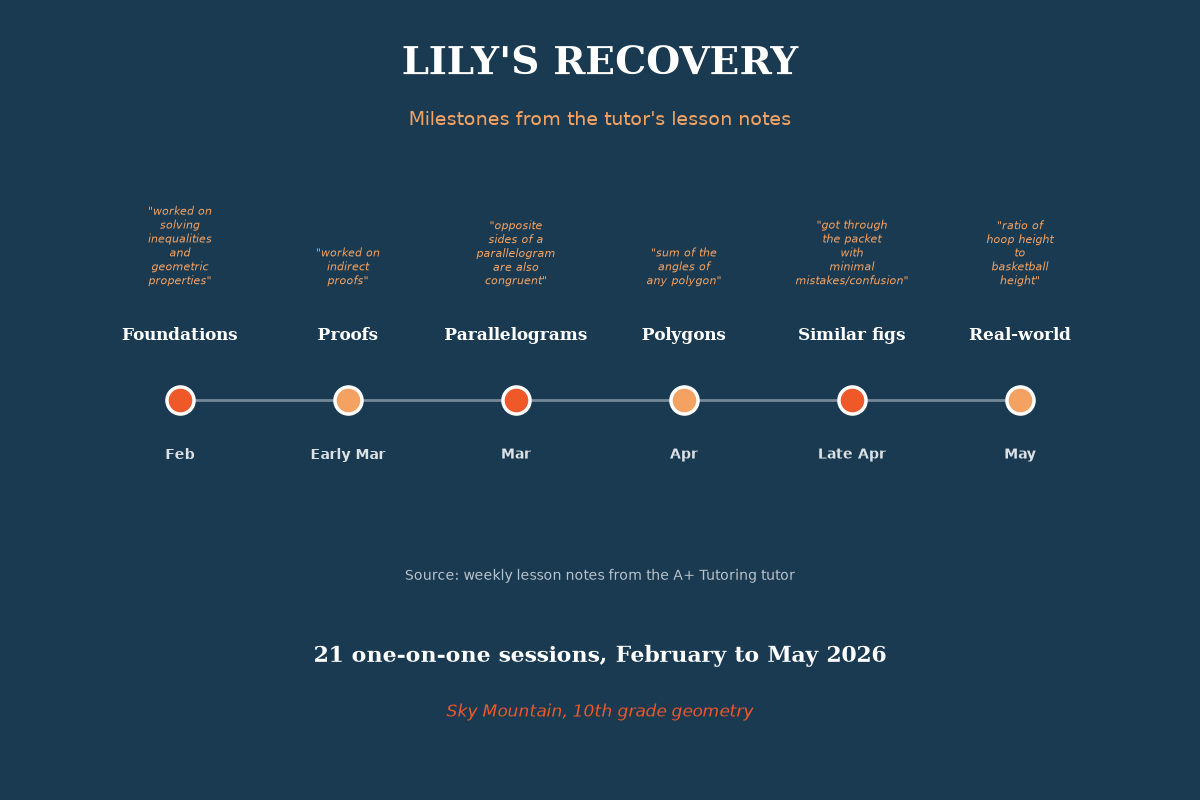
The first sessions didn't try to leap ahead to the hardest material on Lily's plate. Gianna started with the foundation underneath the geometry: solving linear equations, inequalities, the triangle inequality postulate. The quieter work that proofs and parallelograms actually sit on top of. If those pieces are shaky, nothing above them will hold.
What was different, from the very first session, was the pace. Gianna wouldn't move on until Lily said the concept made sense. That alone was new.
"She would actually ask her, 'Do you understand it?' before moving on," Adriana said. "And she was like, 'Yeah, it makes sense.'"
For a student who had been shutting down daily, that small check-in, the pause before turning the page, was the thing that let her shoulders drop.
5. The Work
From February through May, Gianna and Lily built geometry back up, piece by piece.
They worked through indirect proofs. The exterior angle inequality theorem. The sum of the interior angles of a polygon, and the trick of dividing any shape into triangles to find it. Exterior angles. Regular polygons and the formula for finding each interior angle. Quadrilaterals, consecutive versus opposite sides, trapezoids and isosceles trapezoids. Then parallelograms. The full stack of theorems about why opposite sides are congruent, why opposite angles are congruent, why consecutive angles are supplementary.
By late April they were into similar figures: congruent versus similar, how to write a similarity statement with the vertices in the right order, how to use ratios like 15/10 = 1.5 to confirm that two figures really are similar. By early May they were applying all of that to real-world problems, including one where Lily converted a 10-foot basketball hoop to 120 inches and set up the ratio of hoop height to basketball height.
Alongside the new material, Gianna kept circling back to the same under-the-hood skill: solving linear equations. Session after session, that was the "between-lesson" practice. Not because Lily couldn't do it, but because Gianna could see that every proof, every missing angle, every scale factor would eventually come back to isolating a variable.
The other thing Gianna did, and this is the part Adriana still brings up, is she offered Lily her email. If Lily got stuck on a non-session day, she could reach out.
"The help was really there even on the days they were not meeting."
Lily rarely needed to use it. But knowing the door was open changed what Tuesday-to-Thursday felt like. The week stopped feeling like a cliff.
6. The Turning Point
The shift wasn't a single test score. It was quieter than that, and Adriana noticed it at home before anyone at school did.
One afternoon, Lily sat down with her math packet, and just worked. No tears. No circling the room first. No negotiating about whether today was a math day. She opened it, read the problem, and tried.
She still got stuck. She still asked questions. But the stress that used to come before the work had lifted. The problem was once again just a problem, not a referendum on whether she was smart.
That was the moment Adriana knew something structural had changed.
7. The Outcome
Across 21 one-on-one sessions from February through May 2026, Lily moved from avoiding math to engaging with it independently, and the gains showed up where they count.
On her most recent assessment in her school's math program, Lily earned what Adriana described as "a really good score." It was the first strong math result of the school year. Her tutor's session notes track the same climb: by late April, Lily was completing similar-figures problems "with minimal mistakes/confusion"; by early May she was persisting through multi-step proportion problems and connecting new concepts back to earlier ones on her own.
The soft outcomes matter just as much. Lily now takes on challenges she would have refused in January. She works more independently. And the daily tears are gone.
"Before, she was constantly crying and getting frustrated. Now, she still struggles here and there, but she understands better and is able to solve the problems." — Adriana, Lily's mother
Her tutor Gianna noted in a recent session that Lily "showed persistence when working through the proportion problems and made good connections between the mathematical concepts and practical situations," the kind of language that didn't appear in notes from February.
8. Where She Is Now
Lily is finishing out her 10th-grade year with geometry no longer running her week. Gianna is continuing to build out her independence with real-world applications of similar figures and the next units in her curriculum. Adriana has already said she'll reach out again next year if the next course brings new challenges, which, in high school math, it usually does.
The goal from here isn't to make Lily need a tutor forever. It's the opposite. Each session is another piece of math Lily owns by herself.
If your 9th or 10th grader is dreading math (not just struggling with it, but avoiding it), our team can help you figure out what's actually going on and whether 1-on-1 tutoring is the right fit. Learn more about how A+ tutors work with high-school students or see how we support homeschool and charter families.
A+ Tutoring holds the NSSA Tutoring Program Design Badge, awarded by Stanford University's National Student Support Accelerator (2024-2026) after an evidence-based review of our program design and alignment to Tutoring Quality Standards.