.jpg?width=110&height=79&name=Hi-Res%20Logo%20%20(320%20%C3%97%20230%20px).jpg "Hi-Res Logo (320 × 230 px)")
.jpg?width=145&height=104&name=Hi-Res%20Logo%20%20(320%20%C3%97%20230%20px).jpg "Hi-Res Logo (320 × 230 px)")
A note on privacy: this is a real A+ Tutoring student's story, shared with their family's consent. Names and identifying details have been changed to protect their privacy; the tutor is named with permission.
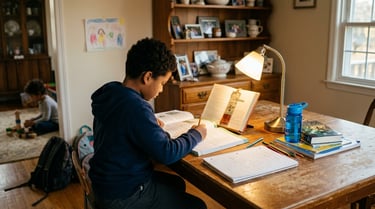
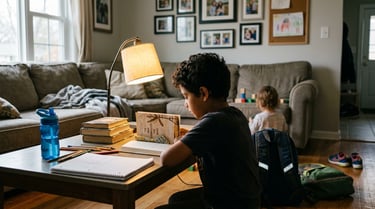
Before tutoring started, Carter, a 3rd grader at a charter school in Northern California, couldn't read. Not really. He couldn't recognize the simplest words on a page. Not "the," not "a," not "is." When his mom Alejandra sat with him at the kitchen table and watched him try to sound out a sentence, he would freeze. Long words shut him down completely. He'd stop, look away, and the frustration would build until the homework was over before it had really begun.
By the end of his time with A+ Tutoring, Carter was reading full pages of short stories aloud, beginning, middle, and end, and his mom was watching him do something she hadn't seen before: separate a long word into syllables, take a breath, and just read it.
This is the story of how that shift happened.
The kitchen-table standoff
For a long stretch of 3rd grade, reading at Carter's house meant a quiet, slow battle. Carter is a bright kid who listens carefully and has plenty of ideas. But when a page was put in front of him, the words wouldn't come.
The simplest words, "the," "is," "a," "see," weren't automatic yet. And the longer ones? Those were worse. Carter would see a multi-syllable word coming on the page, his shoulders would tense, and he'd lock up. "He was, like, frozen when he was about to read a long word," Alejandra said.
He wasn't refusing. He genuinely didn't have the tools yet to break a word apart and put it back together. And the more often that happened, the more reading started to feel, in his own head, like something he couldn't do.
The day Alejandra called
What pushed Alejandra to reach out wasn't one big incident. It was the slow accumulation of watching a 3rd grader fall further from where 3rd graders are supposed to be. School assessments confirmed what she was already seeing at home. Carter's reading was testing at a kindergarten level on his school's i-Ready benchmark, and it wasn't moving.
She wasn't looking for a miracle. She was looking for somebody who would actually sit with Carter, take him exactly where he was, and not skip steps. She wanted a real teacher, not a worksheet app.
What had already been tried
By the time A+ Tutoring entered the picture, Carter had been doing what most kids in his situation do: he was getting reading instruction at school, working on his school-issued Chromebook, and trying to keep up. Nothing was wrong with the effort. But the gap between where Carter was reading and where his 3rd-grade classroom expected him to read was too wide for a whole-class lesson to close.
Alejandra needed someone who could go back to the foundation of letter sounds, blending, and short vowels, and rebuild from there without making Carter feel like he was being sent backward.
The match: Fidah
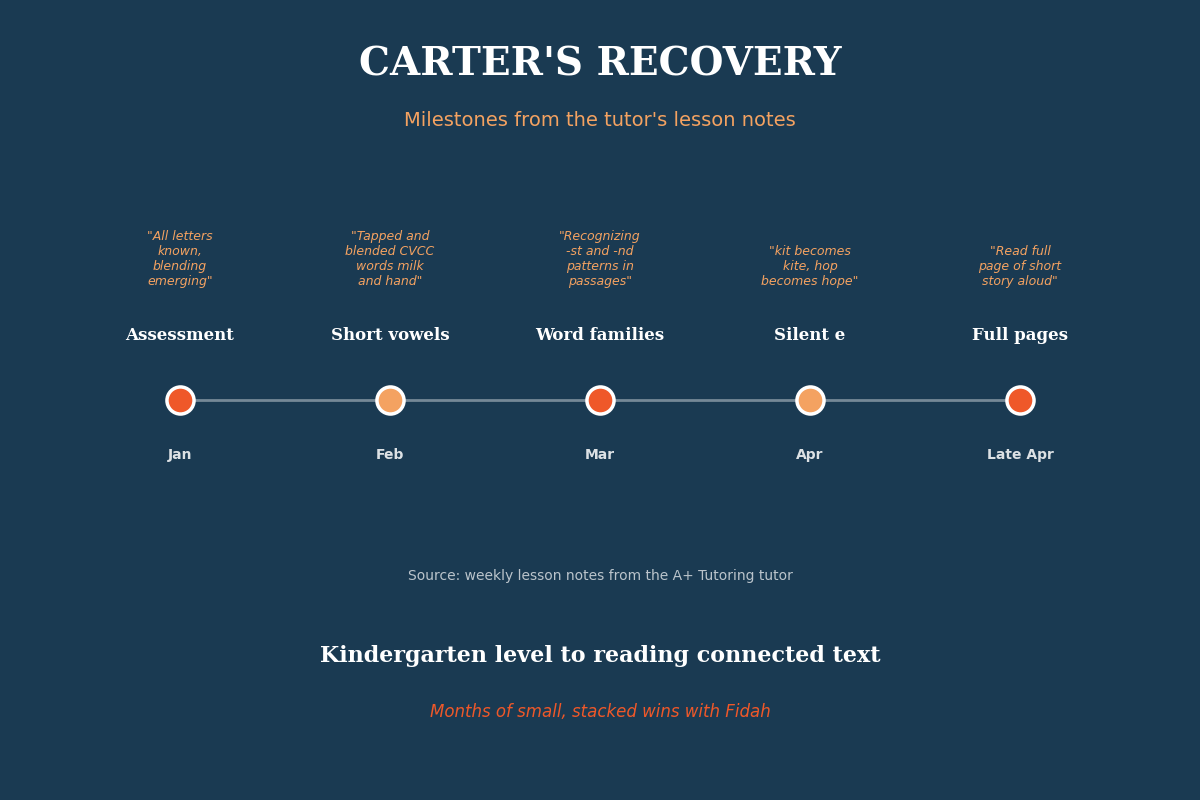
A+ matched Carter with Fidah, a tutor whose approach is patient, structured, and deeply hands-on. From the first sessions, Fidah did something that mattered: she met Carter at his actual reading level, not his grade level. She started with letter recognition and short-vowel sounds (short a, short o, short u) and built up from CVC words like cat, sit, bug into longer patterns with consonant blends.
She also did something Alejandra noticed immediately: she taught Carter how to attack a word. Tap each sound, blend it, then read it smoothly before moving to the next one. It gave Carter a procedure he could trust.
"She really put so much effort to help him, and she was very well prepared all the time." . Alejandra, Carter's mother
The work: months of small, stacked wins
Carter and Fidah met multiple times a week for short, focused sessions. The lessons were never passive. Fidah used an interactive whiteboard where Carter could write, drag letters around, and build words himself. They watched short videos and then talked about what happened. They acted out verbs. They sorted words by their endings: -nd words like hand, sand, bend in one column, -st words like nest, best, rest in another.
Some sessions were hard. Carter had days when he was distracted, days when he was sick with a cough, days when the Wi-Fi cut out and they finished the lesson in the car. He had days when his focus drifted and Fidah had to bring him back gently. But every session, something got built.
Fidah moved him from short vowels into final consonant blends. From CVC words into CVCC words. From CCVC words into reading short decodable passages like The Best Wind and Pets at the Pond. She introduced silent e, so kit becomes kite, tap becomes tape, and hop becomes hope, and Carter started to see how English actually works.
The session notes that Alejandra got after every lesson became her own roadmap. She could see what Carter had practiced, what he'd struggled with, and exactly what to reinforce at home. "Very useful," is how she described them.
The turning point: the day he read a full page
The shift didn't come from one lesson. It came on the day Alejandra sat near Carter while he was practicing and realized he was reading a full page of a short story out loud. Not word-by-word, not frozen, just reading. He got to the end. He'd understood it. And then he looked up, proud of himself.
"He was very happy when he could read a full page of a short story. That was something that . I know tutoring had a lot to do with that." . Alejandra, Carter's mother
![Pull quote: He was very happy when he could read a full page of a short story. [I] know tutoring had a lot to do with that.](https://blog.wetutorathome.com/hubfs/aplus-blog-images/pull-quote-s2-with-logo-2026-06-08-case-study-carter.png)
That was the moment Alejandra knew the work was working. Not because of a score. Because of her kid's face.
Where Carter is now
By the end of his sessions, Carter had moved from being unable to recognize simple sight words to reading at roughly a 1st-grade level. That is a meaningful jump for a child who had been testing at a kindergarten level on i-Ready and not budging. His decoding of full sentences improved. His confidence with longer words changed completely. And the syllable-separation strategy Fidah taught him stuck: when Carter sees a long word now, he doesn't freeze. He breaks it apart.
The school's standardized assessment hasn't caught up to what Alejandra and Fidah are seeing in real reading yet, and that's normal. Benchmark tests lag behind the actual skill growth, especially for kids climbing out of a deep gap. But the in-session progress monitoring tells the story clearly: Carter went from being unable to read simple CVC words independently to reading connected text, answering comprehension questions in complete sentences, and dictating his own ideas about what he read.
He also changed as a learner. He started taking on harder words instead of avoiding them. He started talking more positively about school. He started self-correcting when something didn't sound right, a skill that only shows up when a kid finally trusts that they can figure it out.
"I would recommend A+ . a ten out of ten. It was a good experience." . Alejandra, Carter's mother
What's next
Alejandra plans to continue tutoring with Fidah into next school year. The foundation is built. Now the work is about fluency, stamina, and bringing Carter steadily closer to grade-level reading so 4th grade doesn't feel like a wall. The A+ team is staying with the family for the long haul, because closing a reading gap this size isn't a six-week project, and Carter's family knows it.
If your child is below grade level in reading, our team can talk through what's actually going on.
Get Your Child the Reading Support They Need
Learn more about how A+ tutoring works and our approach for homeschool families.