.jpg?width=110&height=79&name=Hi-Res%20Logo%20%20(320%20%C3%97%20230%20px).jpg "Hi-Res Logo (320 × 230 px)")
.jpg?width=145&height=104&name=Hi-Res%20Logo%20%20(320%20%C3%97%20230%20px).jpg "Hi-Res Logo (320 × 230 px)")
A note on privacy: this is a real A+ Tutoring student's story, shared with their family's consent. Names and identifying details have been changed to protect their privacy; the tutor is named with permission.
Ethan is a 6th grader who used to hesitate before doing homework with anyone other than his dad, his mom, or his ES teacher. He didn't want to get it wrong in front of a stranger. Reading was the subject that worried his family most, and after a school meeting to talk through what kind of support might help, his father started looking outside of school. Within a week of starting tutoring with Hannah T. at A+ Tutoring, that hesitation started to shift. By the end of the school year, Ethan was rereading his own work, catching his own mistakes, and asking his dad when he could see his tutor again next year.
The homework that used to feel like a wall
Homework at Ethan's house was not a scene of tears or slammed doors. It was quieter than that, and in some ways harder to name. Ethan is a careful kid. He is cautious with people he doesn't know well, and he was cautious with schoolwork too. If a reading passage looked long, or a math problem had more than one step, he would slow down and wait. Not refuse. Just wait.
His dad noticed it most in reading. Ethan could sound out the words. He could get through the passage. But asking him to say what the passage was about, or to point to the sentence that proved his answer, was a different thing. He would look at his dad instead of the page.
Sixth grade at a charter school in Northern California asks a lot of a student in that spot. The reading gets denser. The math moves from arithmetic into fractions, decimals, and unit conversions. History and science start expecting you to pull evidence from a text on your own. Ethan needed someone in his corner who could sit with him across all of it.
The moment his dad decided to reach out
The turning point for the family was a meeting at school. Ethan's ES team and his father sat down together to talk about the reading piece specifically. What was working, what wasn't, and what kind of outside support might help. His dad walked out of that meeting knowing two things. One, Ethan was going to need more than what a single school day could give him. Two, whoever worked with Ethan was going to have to earn his trust before any real learning could happen.
"He's one where he's very cautious with people when it comes to doing homework with other people other than me or his ES or his mom."
That was the brief his dad brought to A+ Tutoring. Not "fix his reading." Something quieter and harder: find someone Ethan will actually open up to.
What the family had already tried
Ethan had support at school. He had a father who sat with him at the kitchen table. He had a mom and an ES teacher who knew his patterns. What he did not have was a consistent one-to-one adult whose only job, twice a week, was Ethan. His homework, his questions, his pace. School support is a group setting. Home support comes wrapped in being someone's kid. Neither of those is the same as a tutor whose entire hour belongs to you.
That gap is the exact space A+ Tutoring was built for.
The match with Hannah
A+ matched Ethan with Hannah T., a tutor who works across math, ELA, science, and history. That mattered, because Ethan's homework didn't come in one subject at a time. It came in a stack.
From the first session, Hannah did something Ethan's dad noticed right away: she took her time. She didn't rush the introductions. She didn't push through a warm-up just to get to the "real" work. She let Ethan lead her into what he was working on that day.
She also asked a question that told his father everything he needed to know about who he was working with: is there anything else you'd like me to work on with him? Not "here's my plan." An open door.
The work, week after week
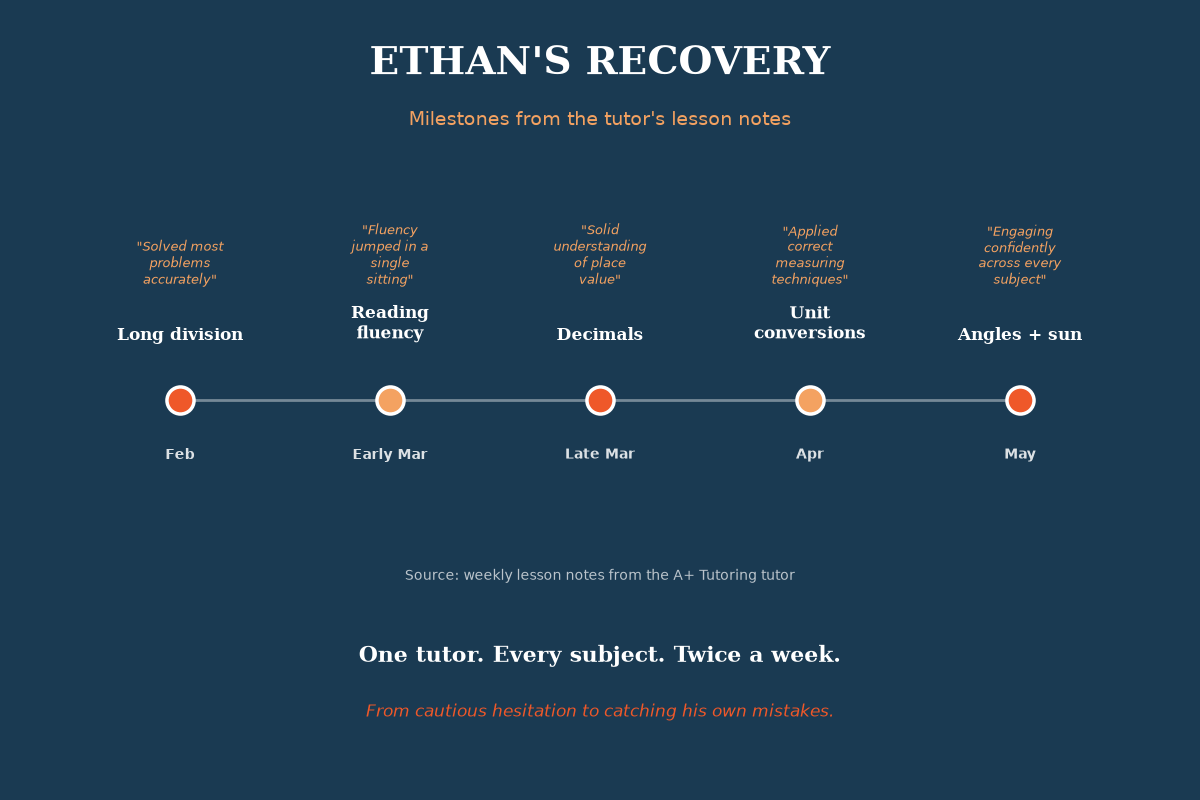
Sessions with Hannah were multi-subject by design, because that's what sixth grade actually looks like on a Tuesday. In one session Ethan might move from long division, to a reading passage about giant beavers in South America, to a discussion about World War I and the Great Depression, to matching types of precipitation to their definitions. Hannah kept the pace even and the tone light.
The reading work was steady and specific. Ethan read passages aloud, then answered comprehension questions that asked him to find the main idea, point to supporting details, and use context clues to figure out new vocabulary. He got faster. He got more accurate. In one session, working through a series of rhyming words, his fluency jumped noticeably in a single sitting.
The math work built the same way. Ethan practiced long division with and without remainders. He worked with fractions. Equivalent fractions, converting improper fractions to mixed numbers, subtracting mixed numbers. He learned to convert between kilometers, meters, miles, and feet, and to hold onto relationships like 1 mile = 5,280 feet while working through multi-step problems. When he mixed up metric and imperial units on a measuring exercise, Hannah stopped, showed him the difference on a ruler, and had him try again. He got it.
The through-line Hannah kept pulling on wasn't a single subject. It was Ethan's willingness to check his own work before asking for help.
The moment his dad knew it was working
About a week in, Ethan's father was sitting next to him during homework, math, or maybe English, he couldn't remember which, and he saw Ethan do something new. Ethan finished a problem, looked at it, decided he wasn't sure, and went back and tried it again. On his own. Before asking his dad to check it.
"He's really thinking a lot. And if he feels like he didn't come in right, he looks at it again and tries again before having me just verify." . Ethan's father
That is the moment. That is what independence looks like in a sixth grader. It is not a test score. It is a kid deciding, without being told, that his own second look is worth something.
Where Ethan is now
By his final session in May, Ethan was engaging confidently across every subject Hannah brought him. In that last lesson he worked on identifying and comparing angles, pulled the main idea out of an informational passage, and talked through the structure of the solar system: the sun's core, corona, convection zone, sunspots. Hannah gave him a small celebration image at the end of the session to mark the end of sixth grade. He was proud.
His father filled out the Student Spotlight survey a few days later. Under positive changes, he checked more independent and self-driven and talks more positively about school and learning. Under how would you describe your tutor, he checked knowledgeable and well-prepared, patient and encouraging, and great at making concepts click.
Asked how likely he'd be to recommend A+ to another family, on a scale of zero to ten, he didn't hesitate.
"If I could give her 50 stars, I would." . Ethan's father
He also said, without being prompted, that if Ethan wants tutoring again in seventh grade, he wants Hannah back.
What comes next
Ethan is heading into summer with a reading habit, a math foundation that finally holds together, and, most importantly, the experience of being a student who can catch his own mistakes. His family knows where to find A+ when seventh grade starts asking harder questions. Hannah is ready when he is.
If your child is quiet about school in a way that worries you, not falling apart, just hesitating, that quiet is often the first signal that they'd benefit from a tutor who has the patience to earn their trust.
Talk to A+ About Your Child's Reading Plan
Learn more about how A+ tutoring works or read another family's story in our MAP Reading intervention case study.